




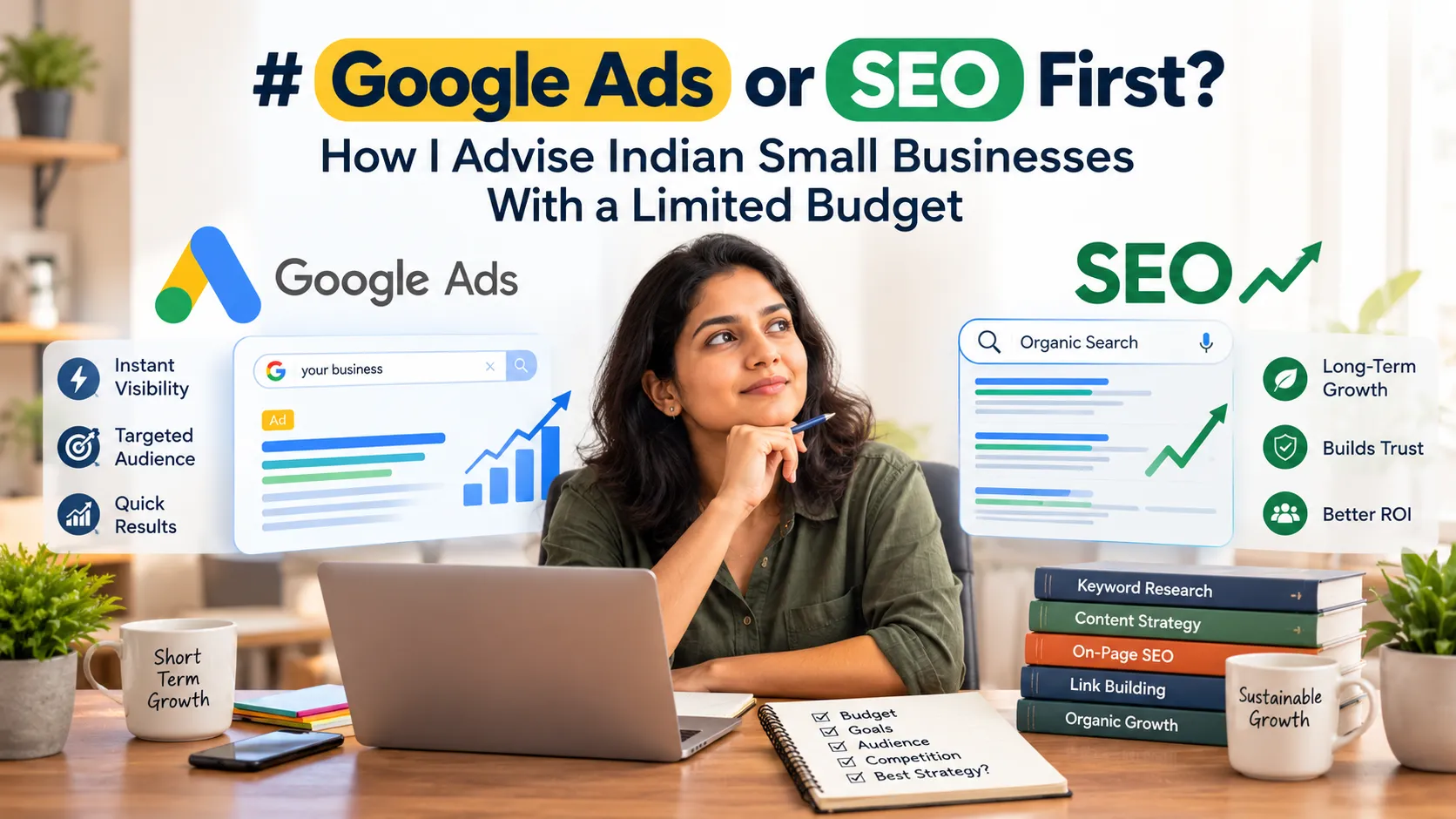
"Should we run Google Ads or do SEO?" is probably the question I answer most on first calls with small business owners. Usually the budget is fixed, the pressure to get leads is real, and someone has told them one of the two is a waste of money.
Neither is a waste. They do different jobs. Here is how I explain the difference, and how I decide what a business should start with.
Quick answer: In the Google Ads vs SEO decision, ads buy visibility today and stop the day you stop paying, while SEO takes months but keeps bringing free clicks. Most Indian small businesses should run a tightly tracked Google Ads campaign for immediate leads and build SEO in parallel, shifting budget towards SEO as rankings grow.
Table of contents
- Google Ads vs SEO: the one-line difference
- What Google Ads does well
- What SEO does well
- How I decide what comes first
- A simple starting split
- Why the best answer is usually "both, in sequence"
- Mistakes I see repeatedly
- A note on Local Services Ads
- My advice
Google Ads vs SEO: the one-line difference
Google Ads rents visibility. SEO builds it.
With Google Ads, you pay Google every time someone clicks your ad. You can appear at the top of results the same day your campaign goes live. When you stop paying, you disappear.
With SEO, you improve your website so it ranks in the unpaid results. It takes months to build, but once you rank, every click is free. Rankings also tend to hold for a while even if you pause work, though competitors will catch up eventually.
What Google Ads does well
Speed. A well-built search campaign can bring enquiries within days. For a new business, a seasonal offer or a festive sale, nothing else is as fast.
Precision. You choose the exact keywords, locations, times of day and devices. A dental clinic in Noida can show ads only to people searching "dentist near me" within a few kilometres, during clinic hours.
Learning. Ads tell you quickly which keywords actually turn into calls and sales. That data is gold for SEO, because it shows which terms are worth months of organic effort.
Where it hurts: costs rise with competition. In categories like insurance, education, real estate and legal services, clicks can get expensive. Poorly managed campaigns also waste money fast: broad match keywords, missing negative keywords and no conversion tracking are the usual culprits I find when auditing accounts.
What SEO does well
Compounding returns. A page that ranks well keeps bringing visitors month after month without a per-click cost. Over a year or two, the cost per lead from SEO usually falls well below paid search.
Trust. Many people skip ads and click organic results, especially for research-heavy decisions. Ranking organically, with good reviews on your Google Business Profile, builds credibility ads cannot buy.
Coverage. SEO captures hundreds of long-tail questions you would never think to bid on. It also feeds AI search: Google's AI Overviews and tools like ChatGPT draw on organic content, not ads.
Where it hurts: time. For a new site in a competitive market, meaningful results often take four to six months or more. If you need leads this month to pay salaries, SEO alone will not get you there.
How I decide what comes first
I ask four questions.
1. How soon do you need leads? If the answer is "this month", start ads now and begin SEO in parallel. If you have runway, SEO deserves a bigger share from day one.
2. How competitive is your category? Check what the top organic results look like. If they are huge national brands and aggregators, SEO for head terms will be slow. Local and long-tail SEO may still be very achievable.
3. How much is a customer worth? If one customer brings in ₹50,000 over a year, paying a few hundred rupees per lead through ads is easy to justify. If your average order is ₹500, paid clicks need to convert very efficiently to make sense.
4. Is your website ready? Neither channel works if the landing page is slow, confusing or has no clear call to action. Sometimes the first rupee should go into the website itself.
A simple starting split
For most small and mid-sized Indian businesses with a monthly marketing budget, this is the starting point I suggest, and then adjust based on results:
| Business stage | Google Ads | SEO and content | Why |
|---|---|---|---|
| New business, needs leads now | About 70% | About 30% | Ads pay the bills while SEO builds |
| Established, some organic traffic | About 50% | About 50% | Use ads data to choose SEO targets |
| Strong rankings already | About 30% | About 70% | Protect and expand what works |
These are starting points, not rules. The right split depends on your category, margins and goals.
Why the best answer is usually "both, in sequence"
The businesses that grow fastest use each channel to make the other better.
Ads show which keywords convert. SEO then targets those keywords for free traffic. As organic rankings improve, ad spend on those terms can come down and move to new keywords or remarketing.
The same landing pages serve both, so improving them lifts results across the board. And remarketing ads can bring back people who first found you through organic search.
Mistakes I see repeatedly
- Running ads without conversion tracking. If you cannot see which clicks became calls or forms, you cannot optimise.
- Sending ad traffic to the homepage. Every ad group should land on a page that matches the search.
- Expecting SEO results in 30 days. Anyone who promises this for competitive terms is either targeting keywords nobody searches or cutting corners.
- Stopping SEO the moment ads work. Then you rent forever. The goal is to need ads less over time, not more.
- Judging SEO by rankings alone. Track organic leads and revenue, not just positions.
A note on Local Services Ads
You may have read that Google is expanding its Local Services Ads format. As we covered in our post on the LSA redesign, these are not available in India today. For now, local businesses here should focus on search campaigns and a strong Google Business Profile.
My advice
If you can only afford one thing this month and you need leads, start with a tightly managed Google Ads search campaign with proper conversion tracking. At the same time, set up your Google Business Profile and fix your website's basics; that part of SEO costs little but time.
As soon as the ads are paying for themselves, start investing steadily in SEO. If you want help deciding, our Google Ads team and SEO team work together, so you get one plan rather than two departments competing for the same budget.