




Every week someone asks me the same question on a discovery call: "Do you do AI SEO?" Google Trends shows searches for "AI SEO" in India up around 40% over the past year, so I understand why. But the question usually hides two different worries. One founder wants to know if AI can make SEO cheaper. Another wants to know why ChatGPT recommends a competitor and not them.
Both are fair questions. They just need different answers. Here is how I explain AI SEO in 2026, what we changed inside ClicZeo, and the parts I still refuse to hand to a machine.
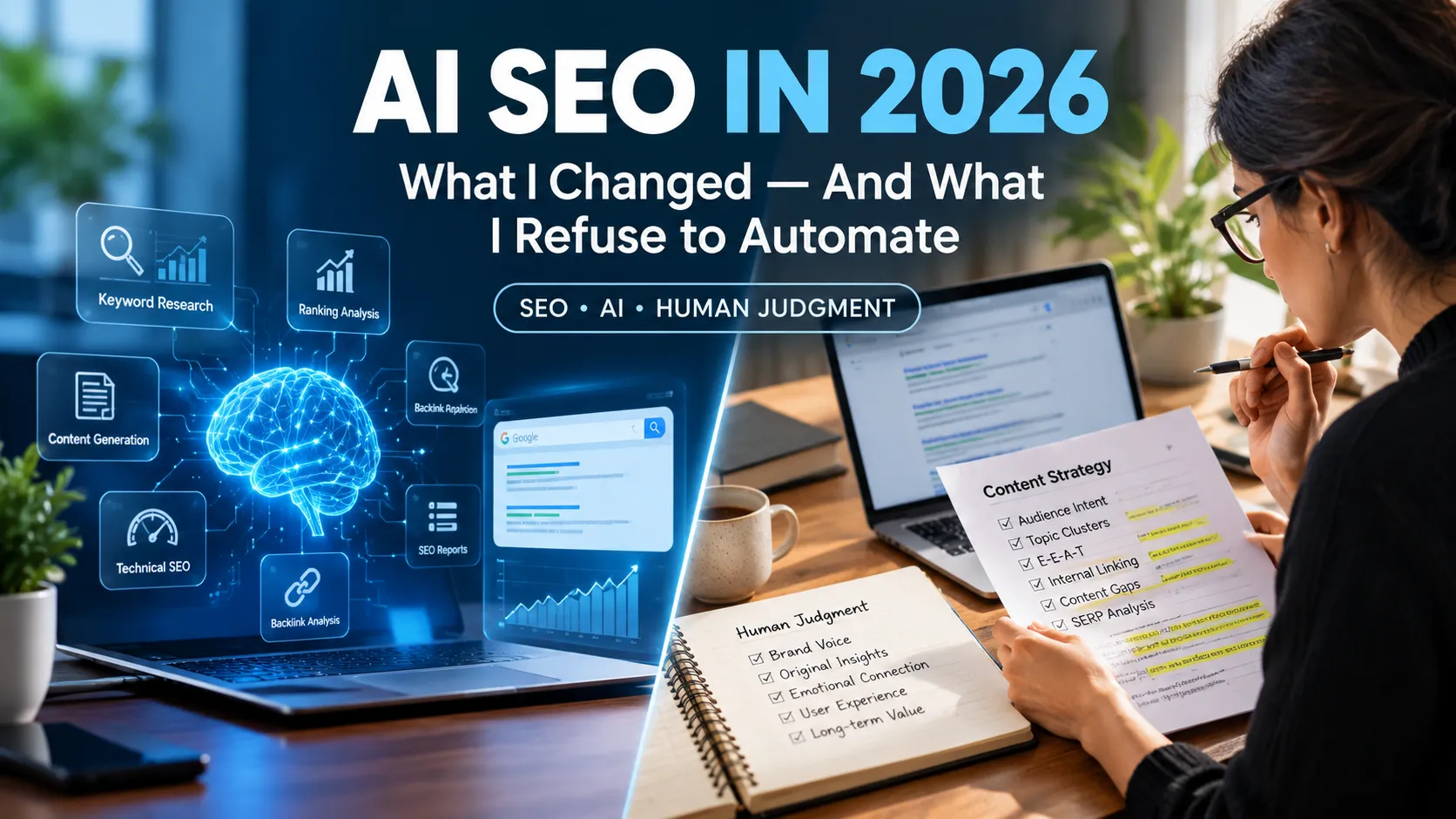
Quick answer: AI SEO in 2026 means two things: using AI to research and work faster, and optimising your content so AI search engines like Google AI Overviews, ChatGPT and Perplexity cite your brand. Speed comes from AI tools; citations come from clear, specific, fact-checked pages and a brand that is easy to identify.
Table of contents
- AI SEO means two jobs now
- What Google said last week matters more than any tool
- What we changed in our own workflow
- How to get cited by AI search, in plain terms
- What I will not hand to AI
- Where Indian businesses stand
- My honest advice
AI SEO means two jobs now
When I say AI SEO, I mean two separate pieces of work.
The first is using AI to do SEO. Clustering keywords, drafting outlines, spotting patterns in crawl data, writing a first version of schema. This is about speed.
The second is optimising for AI-driven search. That covers Google AI Overviews, AI Mode, ChatGPT, Perplexity and Gemini. The goal here is different. You want your brand to be the source these systems quote, summarise or recommend.
Most agencies sell the first and call it the second. That is where I see clients get burned. Faster content does not make you more citable. Clearer, more trustworthy content does.
What Google said last week matters more than any tool
On 1 October 2026, Google updated its guidance on using generative AI content. It now says it is critical to manually fact-check and review all AI-generated content before publishing. That review explicitly covers titles, meta descriptions, structured data and image alt text.
That last part is the one I want every in-house team to read twice. Most teams I audit have a review step for article copy. Almost nobody checks the AI-written meta descriptions or the auto-generated FAQ schema. Those small fields show up directly in search results, so a wrong claim there is visible to everyone.
Google did not say AI content is penalised for being AI. It never has. What it said is that you own the accuracy. That fits the direction of this year's updates, including the September 2026 spam update, which Google gave a two-week rollout window instead of the few days earlier 2026 spam updates took.
What we changed in our own workflow
I'll describe our process plainly, because I think that is more useful than a list of tools.
We use AI heavily for research and lightly for writing. Keyword clustering, SERP pattern analysis, competitor gap lists, internal link suggestions and log file summaries are all AI-assisted now. Work that used to fill a strategist's week now fits into a couple of days. The strategist still makes every call.
We write the first draft of anything opinionated by hand. If a piece needs a point of view, a person writes the argument first. AI then helps tighten it, check the structure and flag missing subtopics. When we tried it the other way round, the drafts read like everyone else's. That sameness is exactly what AI systems skip, because they already have that information.
Every page gets a fact-check with a named reviewer. After Google's 1 October update, we added metadata and schema to that checklist. The reviewer signs off on the page before it goes live. That review is now the slowest step in our content pipeline, and I am fine with that.
We stopped measuring only rankings. We now track whether a client's brand appears in AI Overviews for their core queries, and whether ChatGPT and Perplexity mention them for category prompts. Search Console's AI impressions data helps on the Google side, though it counts appearances, not clicks.
How to get cited by AI search, in plain terms
After a year of testing, these are the patterns I trust.
- Answer the question in the first two sentences of a section. AI systems pull passages, not whole pages. A section that opens with a clear answer is easier to lift and attribute.
- Use specific numbers, names and dates. "Packages start at ₹15,000 a month" gets quoted. "Affordable pricing" does not.
- Make your brand easy to identify. Your name, what you do, where you operate and who runs the business should match across your site, Google Business Profile, LinkedIn and directories. An AI system has to be sure who you are before it recommends you.
- Earn mentions, not only links. Being discussed on industry sites, in forums and in news coverage shapes how language models describe you. A link from a page nobody reads does little here.
- Keep the technical basics clean. If a crawler cannot render your content, no AI system will see it either. Server-side rendering, clear internal links and fast pages still matter.
None of this is magic. It is good SEO, written on the assumption that a machine will read it before a person does.
What I will not hand to AI
Three things stay human on every account we run.
The strategy. Which topics a business should own depends on margins, sales cycles and what the founder is actually good at. A model cannot see that from keyword data.
Original experience. When I write that a technique worked or failed for us, it has to be true. Google's quality rater guidelines give real weight to first-hand experience, and readers can tell when it is borrowed.
Final sign-off on any claim. Health, finance, legal and pricing statements get a human check every time. One invented statistic can cost more trust than a hundred good articles earn.
Where Indian businesses stand
From what I see across businesses in Delhi NCR and beyond, most Indian SMEs are still in the first bucket. They use AI to publish more content, faster. Very few are working on the second bucket: getting named in AI answers.
That gap is the opportunity. If your competitors are publishing more generic content, the brand that publishes fewer, sharper, verified pages stands out to Google and to AI engines. Local service categories are where this shows fastest, because a clear service page with real prices and real reviews has little competition.
My honest advice
If you are starting with AI SEO, do not begin with a tool subscription. Begin with three questions.
- Can a stranger tell, from your top ten pages, exactly what you do and who you do it for?
- Is every factual claim on those pages correct and current, including titles and meta descriptions?
- Does your brand appear when you ask ChatGPT or Google AI Mode for the best option in your category, in your city?
If any answer is no, fix that first. The tools will make you faster. They will not make you right.
If you want a second pair of eyes, our AI-driven SEO team can show you how AI search describes your brand today and what we would fix first. For the citation side specifically, see our Answer Engine Optimization and Generative Engine Optimization services.