




When my relatives ask what I do for a living, I say "SEO" and watch their faces go blank. Then I say "I help businesses show up on Google" and they nod. That second sentence is honestly most of the answer.
"What is SEO" is still one of the most searched marketing questions in India, along with "SEO meaning" and "SEO full form". So here is the plain-language version I give new clients and new team members, updated for how search works in 2026.
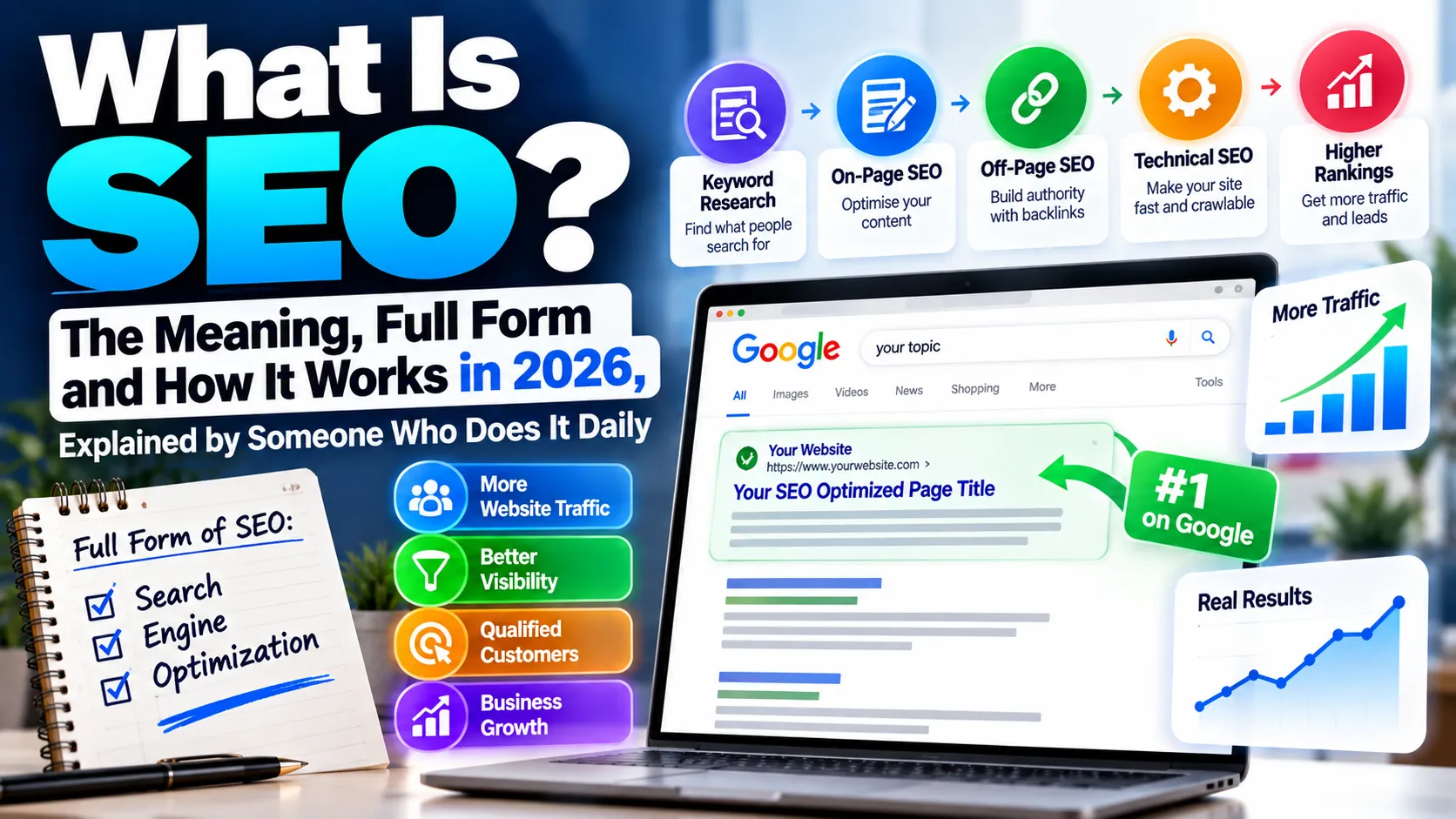
Quick answer: SEO (Search Engine Optimization) is the practice of improving a website so it ranks higher in Google's unpaid results. It covers technical SEO, on-page SEO, off-page SEO and local SEO, and in 2026 it also includes getting cited in AI answers such as Google AI Overviews and ChatGPT.
Table of contents
- SEO full form and meaning
- How Google decides what to rank
- The four parts of SEO
- What is SEO in digital marketing?
- How SEO changed in 2026
- How long does SEO take?
- Can you do SEO yourself?
- Where to go next
SEO full form and meaning
SEO stands for Search Engine Optimization. It is the practice of improving a website so it appears higher, and more often, in unpaid search results on Google, Bing and other search engines.
The key word is unpaid. The ads at the top of Google are bought through Google Ads. The results below them are "organic", and you cannot pay Google to rank there. You earn those positions by being the most useful, trustworthy answer to what someone searched.
One small note: if you searched "SEO" and found pages about Korean actors, that is a different Seo entirely. It is a common Korean surname.
How Google decides what to rank
Google's process has three stages. Understanding them clears up most confusion about SEO.
- Crawling. Google's bots, often called Googlebot, follow links across the web and discover pages.
- Indexing. Google reads each page, works out what it is about, and stores it in a huge index. A page that is not indexed cannot rank, however good it is.
- Ranking. When someone searches, Google pulls the most relevant pages from its index and orders them using many signals: relevance to the query, quality, trustworthiness, usability, location and more.
Google updates these systems constantly. In 2026 alone, it has run two broad core updates, a Discover-specific core update and four spam updates. The direction across all of them is the same: reward pages that genuinely help people.
The four parts of SEO
When I plan SEO for a business, the work falls into four areas.
Technical SEO makes sure Google can crawl, render and index your site. It covers site speed, mobile usability, HTTPS, sitemaps, robots.txt, redirects and structured data. Think of it as the foundation.
On-page SEO is about each page: clear titles, useful headings, content that matches what the searcher wants, internal links and good images. This is where most of the visible work happens.
Off-page SEO is about your reputation elsewhere on the web. Links from respected sites, mentions in news coverage, reviews and a consistent business profile all tell Google that others trust you.
Local SEO helps businesses appear in map results and "near me" searches. For a clinic in Noida or a salon in Ghaziabad, this is often the most valuable part of SEO, and Google Business Profile sits at its centre.
What is SEO in digital marketing?
SEO is one channel within digital marketing, alongside paid ads, social media, email and content marketing.
The way I explain the difference to clients: paid ads are like renting a shop on a busy street. Traffic arrives the day you pay and stops the day you stop paying. SEO is like owning the shop. It takes longer to build, but the traffic keeps coming without a per-click cost.
Most healthy businesses use both. Ads bring quick results and test which keywords convert. SEO builds lasting visibility for the terms that matter most. Content marketing feeds SEO, and social media helps content get noticed and linked.
How SEO changed in 2026
If you learned SEO five years ago, three things are different now.
AI answers sit above the results. Google's AI Overviews and AI Mode often answer a question directly, citing a few sources. Being one of those cited sources is now a big part of SEO. People call this AEO (Answer Engine Optimization) or GEO (Generative Engine Optimization).
Search happens outside Google too. People ask ChatGPT, Perplexity and Gemini for recommendations. Your brand's reputation across the web shapes what these tools say about you.
Quality checks are stricter. On 1 October 2026, Google updated its guidance to say it is critical to manually fact-check all AI-generated content before publishing. Volume alone no longer wins. Accuracy and real expertise do.
The fundamentals have not changed, though. Be useful, be accurate, make your site easy to use, and earn trust.
How long does SEO take?
This is the question every client asks, and the honest answer is: it depends on your competition and starting point.
For a new website in a competitive category, I usually tell clients to expect meaningful movement in four to six months and solid results in about a year. A local business with a well-set-up Google Business Profile can see map pack improvements much sooner. An established site fixing technical problems can sometimes see gains within weeks.
Anyone who promises page one in 30 days for competitive keywords is either targeting terms nobody searches, or taking risks that could get your site penalised.
Can you do SEO yourself?
Yes, especially the basics. Start here:
- Set up Google Search Console and Google Analytics.
- Claim and complete your Google Business Profile.
- Write a clear, unique title and description for every important page.
- Create one strong page for each service you offer.
- Publish helpful content that answers your customers' real questions.
- Ask happy customers for reviews.
You will reach a point where technical issues, competition or time make outside help worth it. That is usually when businesses come to us.
Where to go next
If you want to understand SEO deeply, our digital marketing training programme has a full SEO and AEO module. If you would rather have experts handle it, see our SEO services or, for location-based businesses, our local SEO services.