




I have lost count of the proposals I've seen that promise to "add E-E-A-T" to a website, usually by installing an author box plugin. If only it worked that way.
E-E-A-T is one of the most misunderstood ideas in SEO. It matters a great deal, but not in the way most people describe it. Here is how I explain it to clients, and what we actually do about it.
Quick answer: E-E-A-T in SEO stands for Experience, Expertise, Authoritativeness and Trust. It is not a ranking score or a plugin setting; it describes the qualities Google's systems try to reward. You build it with real first-hand experience, named expert authors, mentions from respected sites and transparent business details.
Table of contents
- What E-E-A-T in SEO stands for
- The biggest myth: E-E-A-T is a ranking factor
- Why E-E-A-T matters more now than two years ago
- How I build each part of E-E-A-T on a client site
- YMYL: where E-E-A-T is non-negotiable
- E-E-A-T and AI search
- A quick self-audit
What E-E-A-T in SEO stands for
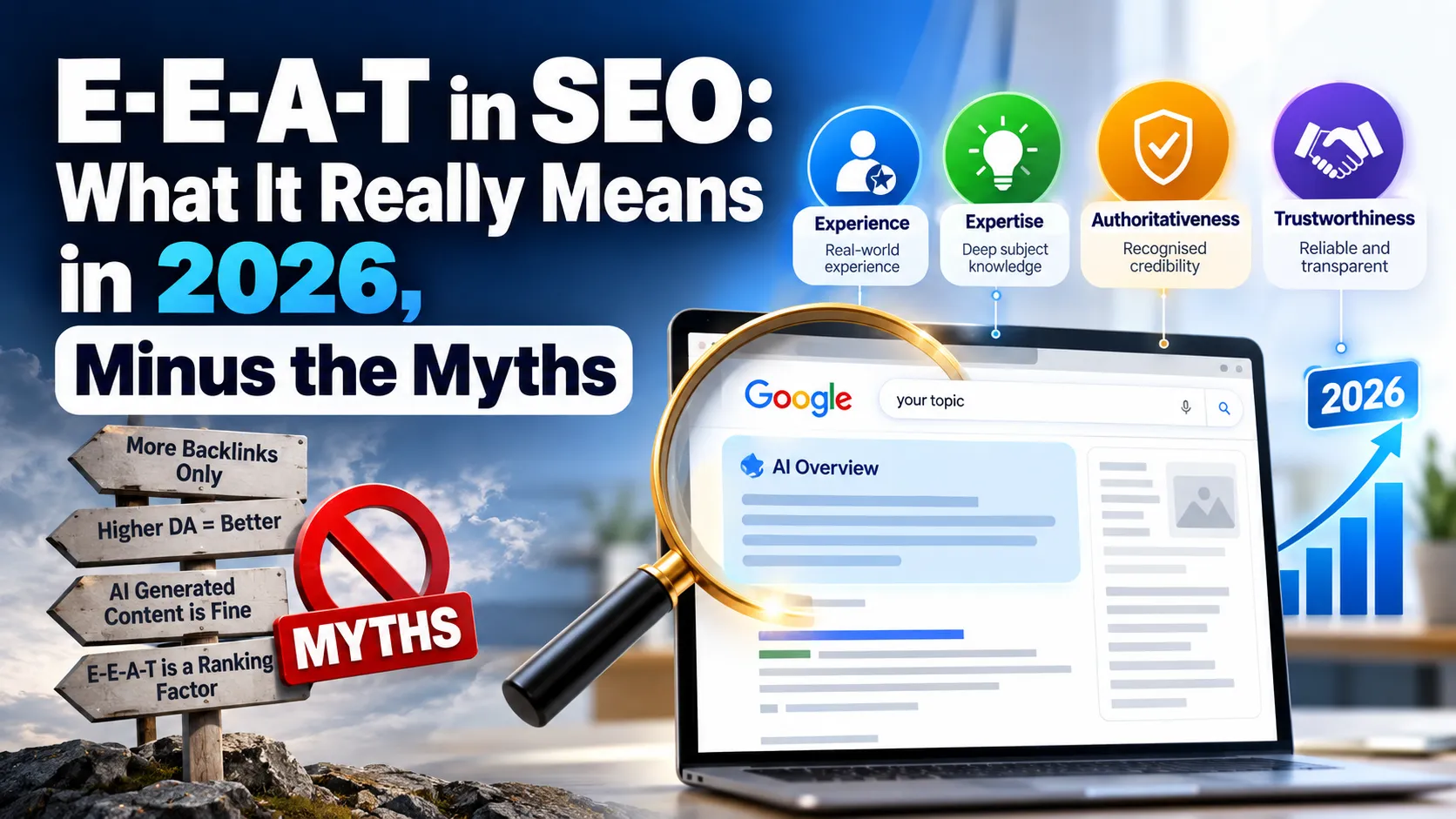
E-E-A-T stands for Experience, Expertise, Authoritativeness and Trust. The terms come from Google's Search Quality Rater Guidelines, the handbook for the people Google pays to evaluate search results.
Experience: has the creator actually done, used or lived the thing they are writing about?
Expertise: do they have the knowledge or skill the topic needs?
Authoritativeness: is the creator or site a recognised go-to source for this topic?
Trust: is the page accurate, honest, safe and reliable?
Google describes trust as the most important of the four. The other three support it. A site can have an expert author and still fail on trust if its claims are wrong or its business details are hidden.
The biggest myth: E-E-A-T is a ranking factor
E-E-A-T is not a single score in Google's algorithm, and no tool can measure it directly. Quality raters do not change rankings either. Their ratings help Google test whether its ranking systems are surfacing good results.
So why does it matter? Because Google builds its systems to reward the same qualities raters look for. The signals that make a rater trust a page tend to be the signals those systems try to find.
The practical way to think about it is this: E-E-A-T describes what Google is trying to reward. Your job is to make those qualities real and easy to see.
Why E-E-A-T matters more now than two years ago
Three changes this year have pushed it up the priority list.
First, on 1 October 2026, Google updated its guidance on AI content to say it is critical to manually fact-check all AI-generated content before publishing. That is a trust statement. Easy content production makes verified accuracy the differentiator.
Second, around the same time, Google expanded its helpful content documentation with a section on main content and how quality raters judge it.
Third, the February 2026 Discover core update said Google identifies expertise on a topic-by-topic basis. A site that writes deeply about one subject can build expertise there even if it covers other topics too. A single article on an unrelated subject is unlikely to carry the same weight.
For anyone chasing Google Discover traffic, that last point changes how you plan content. Depth in a few topics beats a little coverage of everything.
How I build each part of E-E-A-T on a client site
Experience: show that you did the work. This is the easiest part to add and the most neglected. Include your own photos, screenshots, test results and real examples. Write "When we migrated a 2,000-page store, the redirects took three rounds to get right" rather than "Migrations can be complex". If you have not done the thing, say so and cite someone who has.
Expertise: put real people on the page. Every article needs a named author with a bio page. The bio should state relevant qualifications, years in the field and links to their LinkedIn profile or other published work. For health, finance or legal topics, add a reviewed-by line from a qualified professional, such as a doctor, chartered accountant or advocate.
Authoritativeness: be recognised by others. This one you cannot write into your own site. It comes from mentions in industry publications, quotes in news coverage, conference talks, podcasts, and links from respected sites in your field. That is why we treat editorial outreach as an authority project rather than a link count exercise.
Trust: remove every reason to doubt you. This is where Indian business sites most often fall short. Here is my checklist:
- A real registered address and phone number, consistent with your Google Business Profile.
- An About page that names the founders or leadership team.
- GST number or company registration details where relevant.
- Clear pricing, or at least price ranges, wherever you can share them.
- A visible editorial policy explaining how content is written, reviewed and updated.
- "Last updated" dates on articles that are actually kept current.
- Sources linked for statistics and claims.
- A privacy policy, terms and secure checkout where money changes hands.
None of these is glamorous. Together, they make the difference between a site that looks like a real business and one that looks like a content farm.
YMYL: where E-E-A-T is non-negotiable
Google applies higher standards to "Your Money or Your Life" topics: health, finance, legal matters, safety and anything that could seriously affect someone's wellbeing.
If you run a clinic, a CA firm, an insurance agency or a fintech product, E-E-A-T is not a nice extra. Without qualified authors, accurate claims and clear business details, you should expect to struggle on competitive queries, however well optimised the pages are.
This is also why we run a separate healthcare authority SEO programme. The bar is simply higher.
E-E-A-T and AI search
The same qualities shape whether AI systems cite you. Google AI Overviews, ChatGPT and Perplexity all lean towards sources that are specific, consistent and widely referenced. A clear author, a verifiable business and accurate claims make your content safer to quote.
In practice, I find that the work that improves E-E-A-T for Google also improves how AI answers describe a brand. It is one of the few SEO investments that pays off on both fronts.
A quick self-audit
Open your most important page and ask:
- Would a stranger know who wrote this and why they are qualified?
- Is there anything on the page that shows first-hand experience?
- Is every claim correct today, including the title and meta description?
- Could a customer find your address, phone number and company details within two clicks?
- Has anyone outside your company mentioned or linked to you on this topic?
Every "no" is a concrete fix. None of them needs a plugin.
If you want help building authority properly, our content marketing and semantic content writing teams build E-E-A-T into the process from the brief onwards, not as an author box added at the end.