




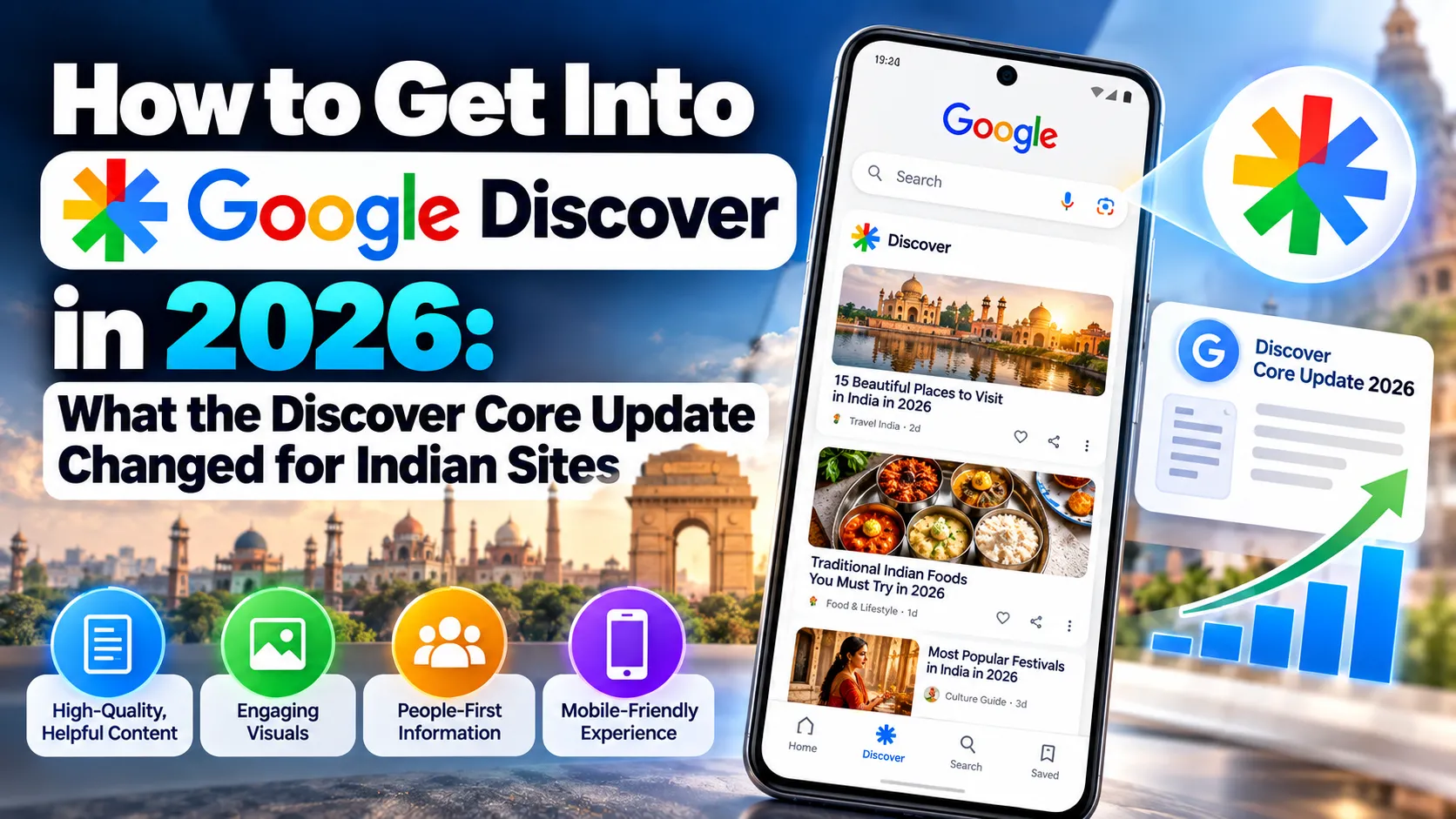
I have watched a single article bring a site more traffic in two days through Google Discover than its best search page brought in a month. I have also watched that traffic disappear just as fast. Discover is the most exciting traffic source in SEO and the least predictable.
Interest in Discover SEO is rising in India, and with good reason. Google changed how Discover works this year, and the change favours exactly the kind of sites many Indian businesses can build. Here is what changed and how I approach Discover now.
Quick answer: Google Discover SEO is about earning a place in people's feeds before they search. After the February 2026 Discover core update, the sites that win publish in-depth, original and timely content on a few core topics, use honest titles and large images, and are based in the reader's country.
Table of contents
- What Google Discover is
- What the February 2026 Discover core update changed
- Why this is good news for Indian sites
- Google Discover SEO: how I set up a site
- How to track Discover traffic
- What to expect, honestly
- Your Discover checklist
What Google Discover is
Discover is the personalised feed in the Google app and on the Chrome new tab page on mobile. Nobody types a query. Google predicts what each user wants to read based on their interests and activity, and shows article cards with large images.
That makes it different from search in one important way. In search, you answer a question someone asked. In Discover, you earn a place in someone's feed before they ask anything.
What the February 2026 Discover core update changed
On 5 February 2026, Google released its first core update built specifically for Discover. Earlier core updates affected Search and Discover together. This one treated Discover as its own system.
Google said the update had three aims:
- More locally relevant content, from websites based in the user's country.
- Less sensational content and clickbait.
- More in-depth, original and timely content from sites with expertise in a given area.
Google also said it judges expertise topic by topic. A site with a dedicated section on one subject can earn expertise in it, even if the site covers other subjects too. A one-off article on an unrelated topic is unlikely to get the same treatment.
The rollout started with English-language users in the US, and Google said it would expand to all countries and languages in the following months.
Why this is good news for Indian sites
The local relevance point is the big one. For years, Indian users often saw content from large US and UK publishers in their Discover feed. A preference for sites based in the user's country gives Indian publishers and businesses a clearer opening.
The expertise point helps too. You do not need to be a large news site. A focused business blog that covers one subject in depth, consistently, fits what Google described.
Google Discover SEO: how I set up a site
These are the steps we work through, in order.
1. Get the technical basics right. Discover leans on large images. Use featured images at least 1,200 pixels wide, and make sure your pages allow large previews with the max-image-preview:large robots setting. Pages should load fast on mobile and work without intrusive pop-ups. Google lists page experience among its Discover recommendations.
2. Pick a lane and stay in it. Since expertise is judged by topic, choose two or three subjects your business genuinely knows. Publish on them consistently. A digital marketing agency writing about SEO, Google Ads and AI search builds topical depth. The same agency writing about cricket and recipes does not.
3. Write titles that are honest and specific. This is where most sites trip up. Discover rewards titles that make people want to click, but the update targets sensationalism and clickbait. My rule: the title should make a specific promise the article keeps. "Google's spam update has a two-week window this time. Here's why" works. "You won't believe what Google just did" does not.
4. Publish timely content, fast. Discover favours freshness. When something changes in your field, a clear, well-informed post published within a day or two has a real chance. That is why news commentary in your niche is one of the best Discover formats.
5. Add original value. Rewriting someone else's news story is not enough. Add what only you can add: your own data, a worked example, your view on what it means for your readers. Original and in-depth are two of the three things Google named.
6. Show who wrote it. Every post should carry a named author with a bio that shows relevant experience. This matters for E-E-A-T and fits Google's emphasis on expertise.
7. Try Web Stories. Google's Web Stories format can appear in Discover as well. It suits quick, visual explainers, and it is one reason we publish them at ClicZeo alongside our blog.
How to track Discover traffic
Discover has its own Performance report in Google Search Console. It only appears once your site has received a minimum amount of Discover traffic, so do not worry if you cannot see it yet.
When you can, look at three things:
- Which articles earned impressions, and what they have in common.
- Click-through rate by article, which tells you how well your titles and images work.
- How quickly traffic falls after publication. Most Discover traffic arrives in the first few days.
In Google Analytics, Discover traffic often shows up mixed with direct or organic traffic, so Search Console is the more reliable source.
What to expect, honestly
Discover traffic comes in spikes. One article might bring thousands of visits; the next ten might bring none. That is normal.
I tell clients not to plan revenue around Discover. Treat it as a bonus that rewards good publishing habits. The same habits, such as topical focus, original insight, clear authorship and strong images, also help your search rankings and how AI systems describe your brand.
As with any core update, Google warned that the Discover update could cause traffic swings. If your Discover traffic dropped after February, look first at clickbait-style titles and at articles outside your main topics.
Your Discover checklist
- Featured images at least 1,200px wide, with max-image-preview:large enabled.
- Two or three core topics, covered consistently.
- Honest, specific titles with no bait.
- Timely posts on changes in your field, with your own take.
- Named authors with real bios.
- Fast, clean mobile pages without intrusive pop-ups.
- A monthly look at the Discover report in Search Console.
If you want help building a content engine that earns Discover traffic, our strategic content marketing team plans topics, writes and tracks results. And if you are wondering how Discover fits with AI search, start with our post on AI SEO in 2026.
For more on how Discover is evolving, read our publisher playbook for the "Dive deeper" test and our guide to Discover keyword optimisation.