




Every hiring round, I review CVs that list three or four SEO certificates. Then I ask the candidate to open Google Search Console and tell me why a page is not indexed. Most cannot.
That is not their fault. Many SEO courses still teach SEO the way it worked years ago: meta keywords, keyword density and directory submissions. So before you spend money on an SEO course, here is what I think you should know, from the side of the table that hires.
Quick answer: An SEO course is worth it in 2026 if it gives you structure, feedback and live projects covering Search Console, GA4, technical SEO and AI search. A certificate alone rarely gets you hired; a documented real-world audit or project does.
Table of contents
- Is SEO still worth learning in 2026?
- What I look for when hiring a fresher
- What a good SEO course must cover in 2026
- SEO-only course or full digital marketing course?
- How we teach SEO at ClicZeo
- How to learn SEO if you cannot take a course right now
- My advice
Is SEO still worth learning in 2026?
Yes, but the job has changed.
Search now includes Google's AI Overviews and AI Mode, plus tools like ChatGPT and Perplexity that answer questions directly. Businesses still need people who understand how to make a website visible. They now also need people who understand how to get a brand cited in AI answers, often called AEO or GEO.
The basics have not gone away. Crawling, indexing, site structure, useful content and trust signals matter as much as ever. What has gone is the shortcut-driven SEO many old courses still teach.
What I look for when hiring a fresher
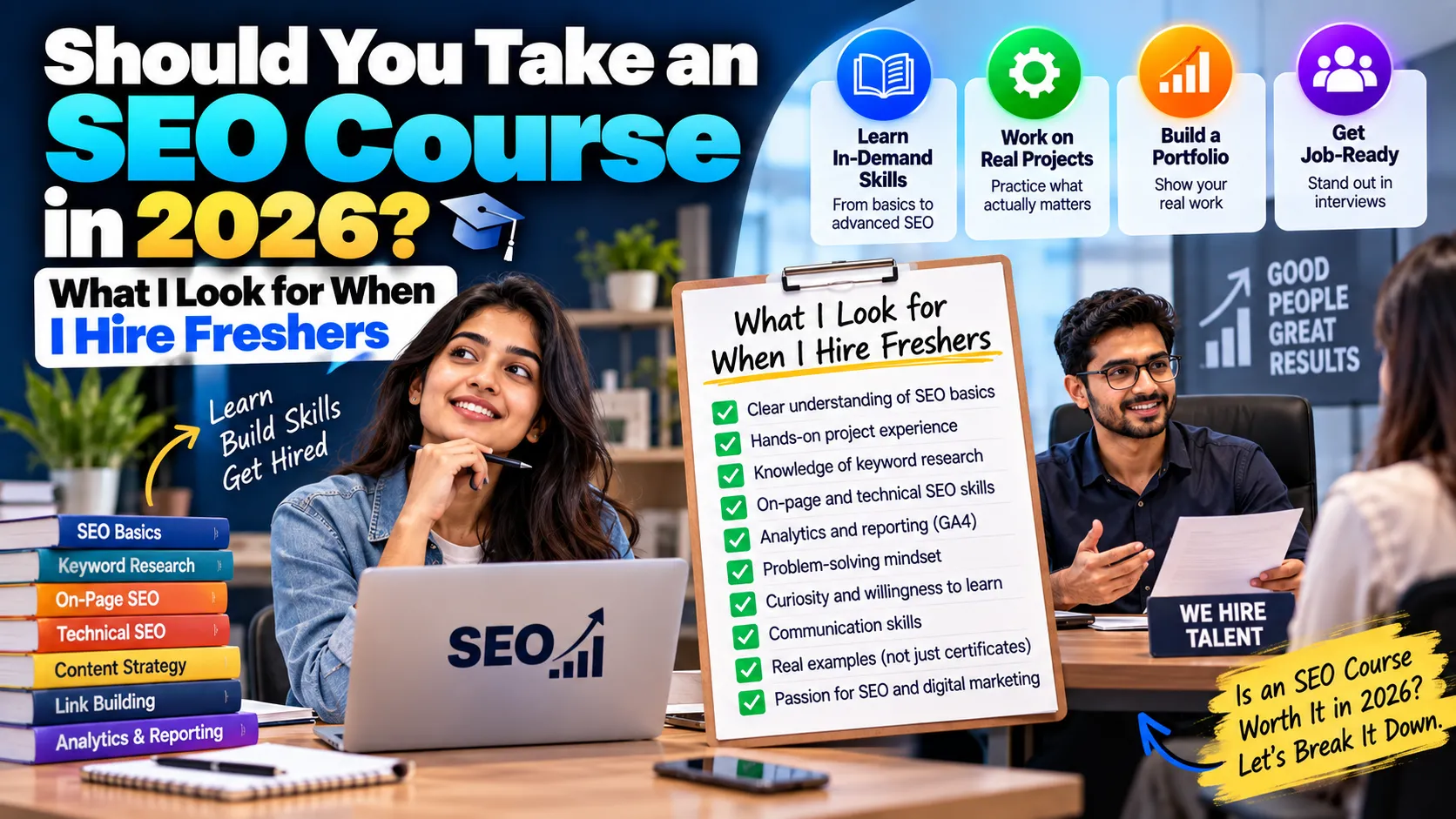
Certificates help a CV get noticed. They rarely decide the interview. These skills do:
- Search Console fluency. Can you read the Pages report, find why a page is not indexed and use URL Inspection?
- A real audit. Have you crawled a real site with a tool like Screaming Frog and turned the findings into a prioritised list?
- Keyword thinking tied to business. Can you explain why one keyword matters more to a business than another with ten times the volume?
- Writing. Can you write a clear, accurate page that answers a question in the first two sentences?
- Analytics. Can you find organic landing pages and key events in Google Analytics 4?
- Curiosity about change. Do you follow what Google announces and know what changed this month?
A candidate with one well-documented live project beats a candidate with five certificates and no real work.
What a good SEO course must cover in 2026
If you are comparing SEO courses, check the syllabus against this list:
- How search engines crawl, index and rank pages.
- Keyword research with search intent, not only volume.
- On-page SEO: titles, headings, internal linking and content quality, including E-E-A-T.
- Technical SEO: sitemaps, robots.txt, HTTPS, Core Web Vitals, mobile SEO and schema markup.
- Google Search Console and GA4, set up from scratch.
- Local SEO and Google Business Profile, which matters hugely for Indian businesses.
- Off-page SEO and how to build links safely.
- AI search: zero-click results, AI Overviews and optimising for answer engines.
- How to use AI tools responsibly, including fact-checking AI output.
- Live projects on real websites, not only theory.
Red flags in a course: promises of guaranteed jobs or salaries, heavy focus on backlink lists and directory submissions, nothing on AI search, and no hands-on projects.
SEO-only course or full digital marketing course?
This depends on what you want to do.
Choose an SEO-focused path if you already work in marketing, content or web development and want to add SEO depth, or you are sure you want to become an SEO specialist.
Choose a full digital marketing course if you are starting your career, want to work at an agency or a startup, or plan to freelance. Most entry-level roles in India expect some knowledge of SEO, Google Ads, Meta Ads and social media together. Small businesses hiring their first marketer want someone who can handle more than one channel.
In my experience, the strongest juniors know one area deeply and the rest well enough to work with others. SEO is a very good "deep" skill to choose, because it connects to content, development, analytics and paid media.
How we teach SEO at ClicZeo
I will be transparent about our own programme, since you are reading this on our site.
Our digital marketing training has five modules across 60 live sessions and 12 hands-on projects. The SEO and Answer Engine Optimization module alone has 15 live sessions. It covers keyword research for AI-driven search, on-page SEO with the E-E-A-T framework, technical SEO, schema, Search Console, GA4 and the audit process.
Students build three SEO projects: local SEO for a home-services business, an SEO strategy for a fintech SaaS platform, and a full technical SEO audit with a roadmap. Those are exactly the kinds of work I ask about in interviews.
There are three tracks. The 1-month bootcamp includes an SEO primer. The 3-month intensive includes the full SEO module. The 6-month programme adds live projects plus paid ads, social media and automation. If you want SEO as a career, the 3-month or 6-month track is the one I would recommend.
How to learn SEO if you cannot take a course right now
You can make real progress for free:
- Read Google's own SEO Starter Guide and Search Central documentation.
- Build a small website or blog on a topic you know.
- Set up Search Console and GA4 on it.
- Crawl it with the free version of Screaming Frog.
- Write ten genuinely useful articles and watch which ones get impressions.
- Offer a free audit to a local business and document what you found and fixed.
That sixth step is your first portfolio piece. Bring it to an interview and you will stand out.
My advice
An SEO course is worth it when it gives you structure, feedback and real projects. It is not worth it when it only gives you a certificate.
If you want to talk through which path suits you, our team is happy to help; there is a WhatsApp link on the training page. You can also read our take on digital marketing careers in 2026.