




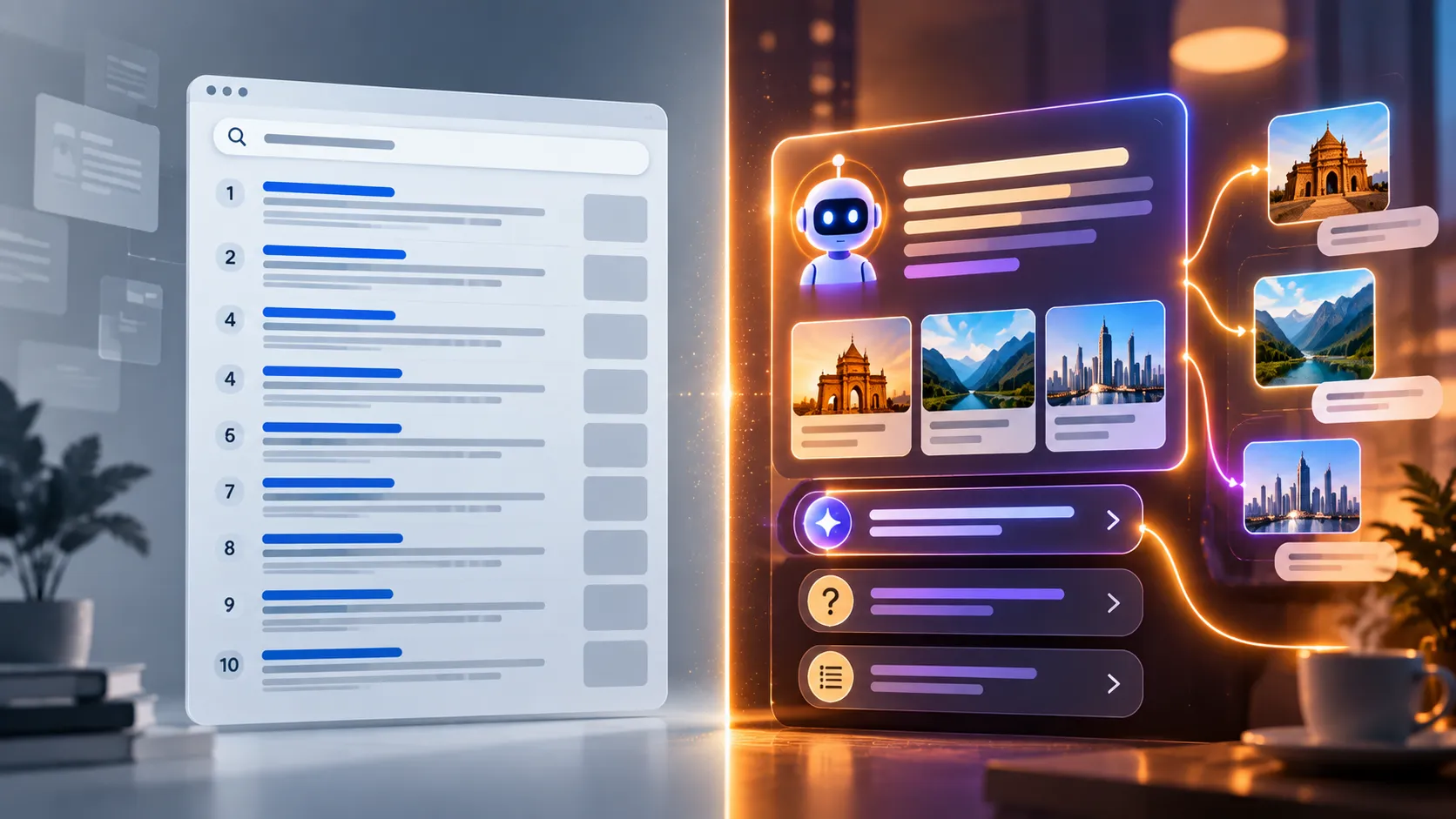
The same Google search box now leads to two very different experiences. One is the classic results page you've optimised for years. The other is AI Mode, a conversational answer engine that India got before almost any other country (Google India blog).
If you're planning SEO, content or ads for 2026, you need to understand how they differ. Here are the seven differences that matter most. (New to AI Mode? Start with our Google AI Mode India guide.)
Quick Comparison
| Traditional Search | Google AI Mode | |
|---|---|---|
| Typical query | Short keywords (2–4 words) | Long, detailed questions |
| Result format | Ranked list of links | Written answer with cited links |
| Follow-ups | New search each time | Continues the conversation |
| Input | Mostly typed text | Text, voice, images, live camera |
| How it searches | Matches one query | Fans out into many sub-queries |
| Click behaviour | User picks from 10 results | User reads answer, clicks for depth |
| SEO goal | Rank high | Get cited |
1. Query Length and Style
Traditional search trained people to type "cheap flights goa". AI Mode invites "cheapest way to fly from Delhi to Goa in December with a toddler, flexible dates". Pew Research found that AI summaries appeared on 53% of searches with 10 or more words, versus 8% for one to two word searches (Search Engine World).
Marketer takeaway: research full-sentence questions from sales calls, WhatsApp enquiries and Quora, not just keyword tools.
2. Multimodal Input
AI Mode accepts photos, voice and live camera through Lens, Circle to Search and Search Live. Google says more people use Lens monthly in India than in any other country. Traditional search is still mostly text-first.
Marketer takeaway: original product photos, descriptive alt text and image-rich pages now affect discoverability.
3. How Results Are Built
Traditional search ranks pages for one query. AI Mode uses query fan-out, splitting one question into many sub-searches and combining the results (Business Standard).
Marketer takeaway: own specific sub-topics deeply rather than chasing only head keywords.
4. Citation Behaviour
On the classic page, position #1 wins most clicks. In AI Mode, several sources are cited across a longer answer, and the order depends on which part of the answer each source supports.
Marketer takeaway: clear, quotable sections with facts and data matter more than overall page rank. See how AI Overviews are already changing organic traffic in India.
5. Conversation and Context
Traditional search forgets you after each query. AI Mode keeps context, so a user can ask "which of these is best for oily skin?" after a product comparison.
Marketer takeaway: create content that answers the natural next question: comparisons, pros and cons, pricing, suitability for specific needs.
6. Ad Implications
In traditional search, ads sit in fixed slots above and below results. Google has been bringing ads into AI Overviews and AI Mode, with ads matched to the context of the whole conversation rather than one keyword. Rollout by market and format changes often, so check Google Ads announcements for current India availability.
Marketer takeaway: broad match, strong product feeds in Merchant Center, and Performance Max or AI-driven campaign types are how advertisers typically qualify for AI surfaces.
7. Measurement
Traditional search gives clear rankings and click data. AI Mode visibility is harder to see: Search Console reports it within overall Search data, and citation positions aren't reported separately.
Marketer takeaway: add manual prompt tracking and track conversions per session, not just rankings.
Should You Optimise for One or Both?
Both. Traditional search still drives the bulk of commercial and navigational clicks, and AI Mode draws on the same index and ranking signals. The shift is in emphasis: keep strong technical SEO, then layer on citation-friendly structure, sub-topic depth and entity strength. Our GEO strategy guide covers that extra layer.
The Bottom Line
Traditional search rewards the best-ranked page. AI Mode rewards the most useful answer to each part of a question. Indian marketers who plan for both will keep today's traffic and earn tomorrow's citations.