




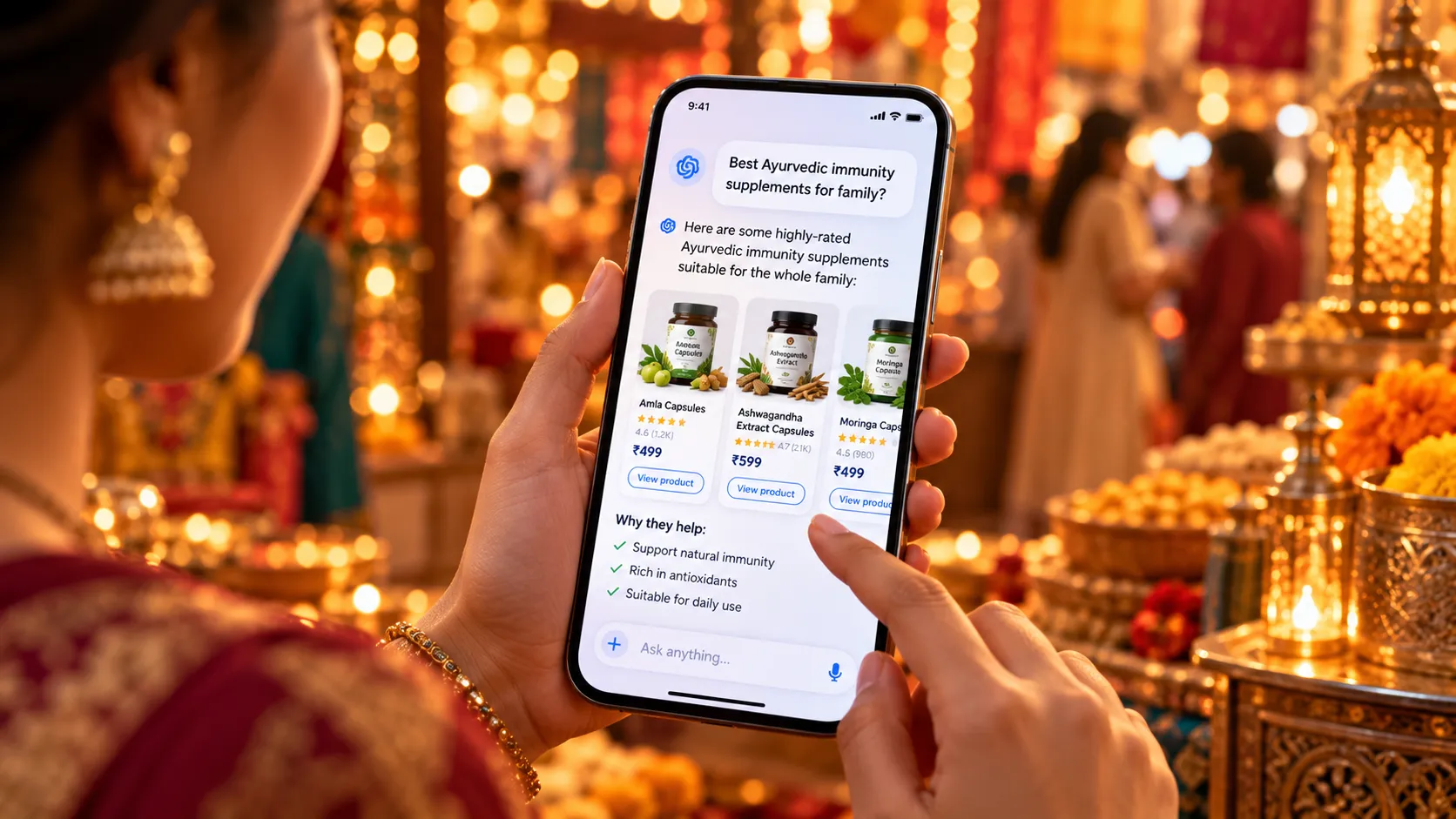
Online shopping in India is changing. Consumers are no longer relying only on short keyword searches to find products. They increasingly use conversational queries, compare multiple options and ask detailed questions before making purchasing decisions.
This shift was discussed by Pushkar Gupte, who leads Consumer Packaged Goods (CPG) at Google India, in an interview published by Social Samosa on 1 October 2026.
His comments highlight two important areas for ecommerce brands: understanding conversational search behaviour and maintaining complete, accurate product information.
For Indian businesses preparing for the festive shopping season, these developments raise an important question: is your product data ready for AI-powered discovery?
Let's explore the interview's key insights and the practical steps brands can take.
What Did Google's CPG Head Say About AI Mode?
In the Social Samosa interview with Pushkar Gupte, the central theme was the changing nature of consumer search.
Gupte described how search queries are becoming more conversational, moving beyond traditional two-to-three-word phrases.
Instead of searching for just "wireless headphones," shoppers may ask:
- Which wireless headphones are best for office calls under ₹3,000?
- Compare headphones with noise cancellation, long battery life and comfortable ear cushions.
- Which headphones are suitable for travel and online meetings?
These queries combine multiple requirements in a single interaction.
Gupte also emphasized that the underlying principle remains unchanged: answering what the consumer is actually searching for.
For brands, this means product descriptions and feeds should communicate useful product attributes clearly instead of relying exclusively on broad keywords.
How Google AI Mode Is Changing Product Discovery in India
Google has been introducing more conversational and visual shopping experiences across its AI-powered products.
In an April 2026 announcement, Google India described shopping in AI Mode as an experience that brings together product images, prices, reviews, inventory information and comparisons to help shoppers evaluate options. The experience described in that announcement was available in English in India at the time.
Google also highlighted shopping features in Gemini, including product listings and comparisons in English and Hindi.
Read Google's official announcement: New ways Google is using AI to make shopping easier.
For ecommerce brands, the practical implication is that product discovery increasingly involves a combination of text, images, product attributes and purchase-related information.
This does not mean every product will automatically appear in every AI-generated answer. Visibility depends on multiple factors, and Google has not promised guaranteed placement through product feed optimization.
Why Product Feed Quality Matters More Than Ever
A product feed is a structured collection of information about the products an ecommerce business sells.
For Google Merchant Center, this information can include:
- Product title
- Product description
- Price and currency
- Availability
- Brand and GTIN, where applicable
- Product category
- Main image and additional images
- Product landing page URL
- Size, colour and other relevant attributes
If these details are missing, inconsistent or outdated, Google may have difficulty accurately representing a product.
For example, imagine an Indian skincare brand selling sunscreen.
A basic product title might be:
"Daily Sunscreen SPF 50"
A more informative product title could be:
"SPF 50 PA++++ Sunscreen for Oily Skin, 50 g"
The second title communicates additional product attributes, assuming those details are accurate and supported by the actual product.
Similarly, a complete description can explain the formulation, texture, usage and relevant product specifications without making unsupported claims.
Google's Merchant Center product data specification provides the technical requirements for submitting product information.
Product Images Are Part of the Discovery Experience
Product images are not merely decorative elements. They help shoppers understand what they are considering and allow visual shopping experiences to present products more clearly.
Gupte specifically highlighted the importance of high-quality product images, pack shots and campaign visuals in his interview.
For Indian ecommerce brands, an image optimization checklist should include:
Clear product photography: Use sharp images that accurately show the product and its packaging.
Consistent product presentation: Ensure the image represents the exact variant listed in the feed.
Additional product angles: Include useful secondary images wherever relevant and supported.
Accurate image URLs: Check that images load correctly and remain accessible to Google's systems.
Mobile-friendly product pages: Make sure product images are clear and usable on mobile devices.
For brands preparing festive campaigns, it is useful to maintain both clean product images and relevant lifestyle visuals. The purpose is to support different shopping needs without misrepresenting the product.
5 Steps to Optimize Your Product Feed for AI-Powered Shopping
Here is a practical workflow for ecommerce teams.
1. Audit your existing product data
Export your Merchant Center product information and identify missing or inconsistent fields.
Prioritize products with high sales potential, important seasonal demand or frequent data errors.
2. Write descriptive product titles
Use the most relevant product attributes naturally.
Include the product type, brand, variant, size or other important details where appropriate. Avoid keyword stuffing and unnecessary promotional language.
3. Improve product descriptions
Answer the questions shoppers are likely to ask.
Include relevant specifications, usage details, material or ingredients, compatibility and genuine differentiators.
4. Resolve feed and landing-page mismatches
Compare the information submitted to Merchant Center with the actual product page.
Ensure that price, availability, variants and other important details are consistent.
5. Monitor feed diagnostics
Use Google Merchant Center to review product approval status, data quality issues and account-level notifications.
Fix disapprovals and warnings according to their actual causes rather than making arbitrary changes in the hope of improving AI visibility.
Tools to Help Optimize Product Discovery
Tool | Purpose | Link |
Google Merchant Center | Manage product feeds and diagnose listing issues | |
Merchant Center product data specification | Review required and recommended product attributes | |
Google Search Console | Monitor organic search visibility and website performance | |
Google Trends | Explore product-related search interest and seasonal demand | |
Google Analytics 4 | Measure ecommerce engagement and conversion behaviour | |
Google Rich Results Test | Validate eligible structured data on product pages |
Each tool serves a different purpose. Merchant Center helps manage product data, Search Console measures organic search performance, and Analytics helps evaluate what visitors do after arriving on your website.
Use these tools together to understand the full discovery journey rather than relying on one visibility metric.
What Indian Brands Should Prepare for the Festive Season
India's festive shopping period creates demand across categories such as electronics, fashion, beauty, home decor, gifts and packaged consumer goods.
Brands can prepare by reviewing their best-selling products, checking inventory and price accuracy, improving product photography and ensuring that important product attributes are available in their feeds.
For example, a shopper looking for a Diwali gift may ask for a decorative item under ₹1,500 that suits a modern home. A product listing with accurate material, dimensions, colour, price and images can communicate its suitability more clearly than a listing containing only a generic name.
This is a practical application of conversational shopping principles, not a guarantee that the product will be surfaced by AI Mode.
Final Thoughts
Pushkar Gupte's interview highlights a meaningful change in how consumers interact with search. Queries are becoming more conversational and detailed, while visual assets and structured product information play an important role in shopping experiences.
For Indian ecommerce brands, the next step is not to chase an unverified AI ranking formula. It is to make product information complete, accurate, useful and easy to understand.
Start with your Merchant Center feed, review your product images and improve the information available on your product pages.
As AI-powered shopping experiences continue to evolve, a well-maintained product catalogue provides a practical foundation for helping customers discover and evaluate your products.