




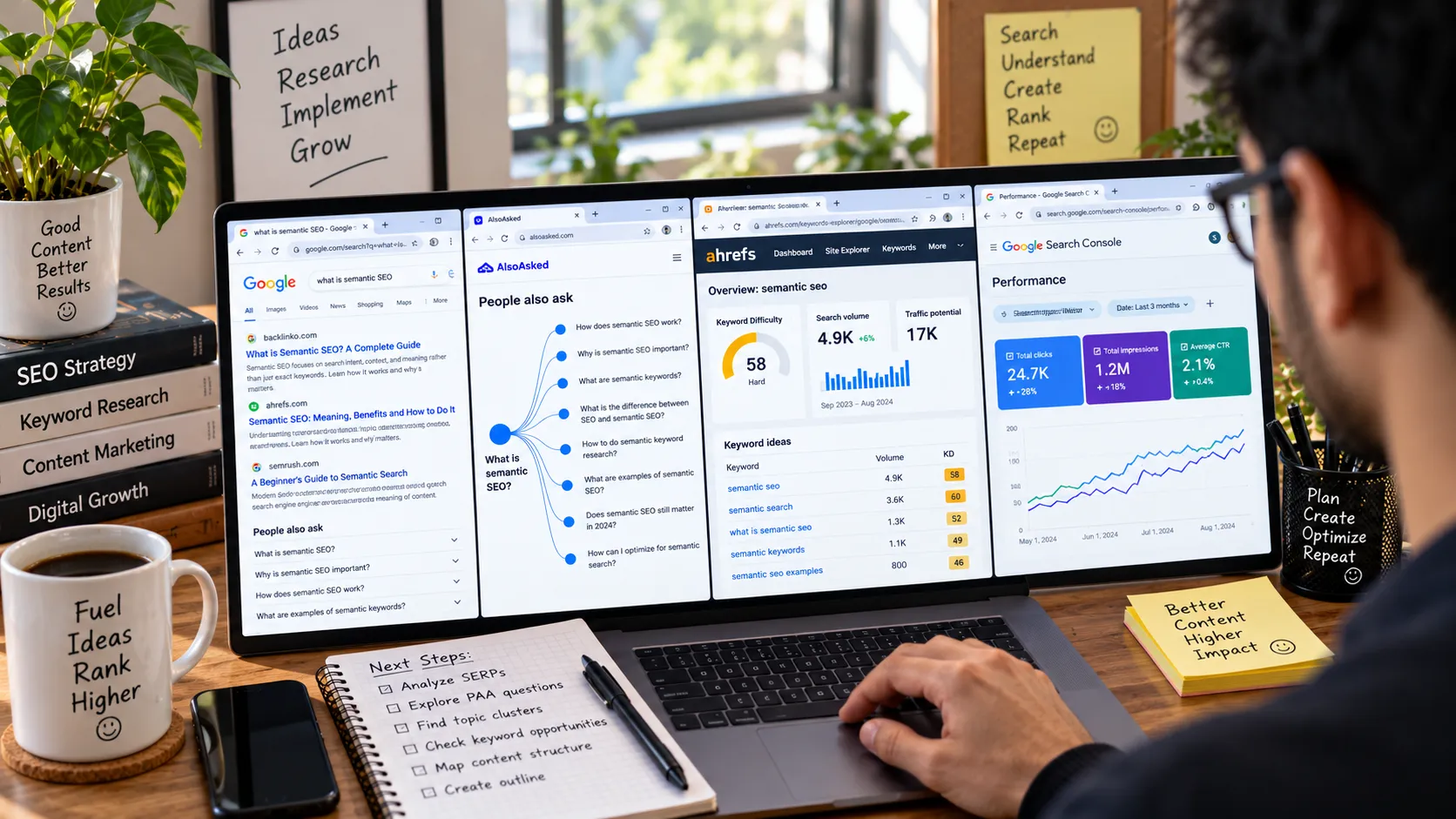
You don't need a $100+ SEO subscription to start doing useful semantic keyword research.
I've used plenty of paid tools over the years, and they're valuable—especially when you're working with large websites or client campaigns.
But for everyday content research, I still rely heavily on free sources.
The important thing is knowing what you're looking for.
Here's my current shortlist.
1. Google Search
This is still my first stop.
I search the main topic and pay attention to:
- Autocomplete suggestions
- People Also Ask
- Related searches
- Featured snippets
- Search result titles
- Questions appearing across multiple pages
The important part is not simply copying these phrases.
I look for patterns.
If several searches keep circling around the same question, that's a signal that the concept probably deserves attention in the content.
This is also where I validate ideas generated during my broader semantic keyword research process.
2. Google Search Console
If I'm researching content for an existing website, Search Console is one of my favorite free sources.
Why?
Because it tells me what Google is already associating with the site.
A page might be getting impressions for queries that weren't part of the original keyword research.
Those unexpected queries can reveal:
- Missing sections
- New content opportunities
- Supporting topics
- Search intent differences
- Pages that deserve optimization
In other words, I'm not starting from zero.
I'm looking at what Google already understands about the website and where there are gaps.
3. Reddit
Reddit is useful for understanding how people actually talk about a problem.
That's different from keyword data.
Someone searching for "best SEO tool" might use very different language when posting:
"I've tried three SEO tools and still can't figure out why my pages aren't ranking."
That second version tells me much more about the underlying problem.
I look for recurring frustrations, questions, comparisons, and terminology.
I don't copy the discussions. I use them to understand the audience.
4. Quora and Forums
Quora and niche forums can be useful for the same reason.
The questions are often imperfect—and that's exactly why they're useful.
They show:
- What beginners misunderstand
- What people want explained simply
- Which concepts cause confusion
- What questions naturally follow another question
Those patterns can become sections, FAQs, or supporting articles.
5. AlsoAsked
AlsoAsked is one of the tools I find particularly useful when I'm trying to understand how questions connect.
Instead of seeing questions as isolated keywords, it can help visualize related questions and the relationships between them.
That's useful when planning a pillar and deciding which questions belong in supporting content.
6. Your Own Analytics and Existing Content
This one doesn't get enough attention.
Before researching a completely new topic, I look at what the website already has.
I ask:
- Which pages are getting impressions?
- Which pages rank for unexpected queries?
- Which topics already attract visitors?
- Where are there obvious content gaps?
- Which old posts could become part of a larger cluster?
Sometimes the best semantic keyword opportunity is hiding inside content you already published.
What Free Tools Can't Do
Free tools are excellent for research, but they have limitations.
They may not give you:
- Large-scale competitor analysis
- Deep backlink databases
- Extensive historical keyword data
- Advanced keyword clustering
- Enterprise-level reporting
- Automated workflows
That's where paid platforms can become useful.
But there's an important distinction:
A paid tool can make research faster. It doesn't automatically make your research smarter.
You still need to understand the audience and search intent.
My Simple Free Research Stack
If I had to start from zero today, my basic stack would be:
Google Search → Reddit/Quora → Google Search Console → AlsoAsked → existing website data
Then I'd manually organize the findings into topic groups.
That's enough to build surprisingly strong content research.
And once the groups are clear, the next step is turning them into a topic cluster, rather than publishing unrelated articles.
That's exactly why I changed the way I plan content in Why I Stopped Publishing Random Articles and Started Building Topic Clusters.