




Keyword research used to mean opening a keyword tool, finding a high-volume phrase, and trying to include it in an article as many times as possible.
I don't work that way anymore.
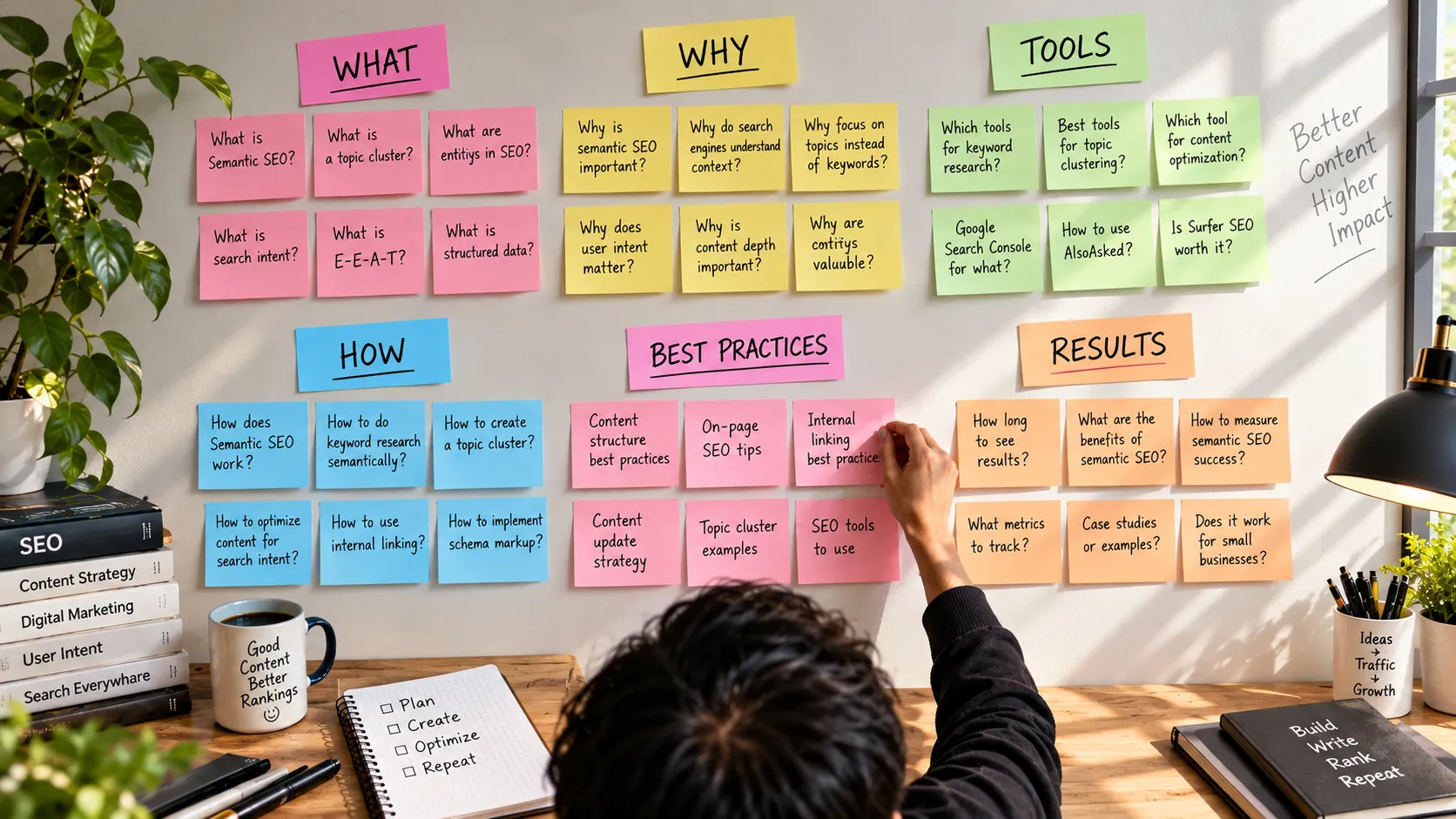
When I research a topic today, I’m less interested in finding one perfect keyword and more interested in understanding the entire search journey around the topic.
Here’s the actual process I follow.
1. I Start With the Topic, Not the Keyword
Before opening a keyword tool, I ask a simple question:
If I were searching for this information, what would I actually want to know?
I write down the obvious questions first.
Then I think about what someone might ask before, during, and after finding the main answer.
For example, if I'm researching "semantic SEO," I wouldn't stop at:
- What is semantic SEO?
- Semantic SEO benefits
- Semantic SEO tools
I'd also explore questions such as:
- How is semantic SEO different from traditional SEO?
- How does Google understand topics?
- What are entities and related concepts?
- How do topic clusters work?
- How do you find related keywords?
- How should internal linking support a topic?
This gives me a much better starting point than a list of keywords alone.
If you want to understand why I moved away from traditional keyword-first thinking, read my guide on Semantic SEO vs. Traditional SEO.
2. I Look at Real Search Questions
This is where the research gets interesting.
I use Google search results, People Also Ask, Reddit, Quora, forums, and other places where people are actually asking questions.
I'm not just collecting keywords.
I'm looking for language, problems, comparisons, objections, and follow-up questions.
Reddit can be particularly useful because people often explain what they tried, what didn't work, and what they're still confused about.
That information can reveal search intent that a traditional keyword list doesn't show.
3. I Build One Big, Messy List
At this stage, I don't organize anything.
I dump everything into one document:
- Keywords
- Questions
- Related concepts
- Subtopics
- Comparisons
- Problems
- Tools
- Examples
- Questions from forums
- Terms appearing repeatedly in search results
It looks messy.
That's intentional.
One of my biggest keyword research mistakes was trying to organize everything too early. I started grouping questions before I had collected enough information, and I ended up missing useful subtopics.
So now I collect first and organize later.
4. Then I Look for Natural Topic Groups
Once the list is large enough, I start grouping similar ideas.
Usually, a few obvious buckets appear.
For example, a semantic SEO topic might naturally break into:
- Semantic SEO fundamentals
- Semantic keyword research
- Topic clusters
- Entities and search intent
- Content optimization
These aren't just keyword groups.
They're conceptual groups.
That's an important distinction.
A semantic content strategy shouldn't simply create a page for every slight keyword variation. The goal is to understand which questions belong together and which deserve their own dedicated content.
For a deeper explanation of this approach, see Why I Stopped Publishing Random Articles and Started Building Topic Clusters.
5. I Decide What Belongs in the Pillar
Now I have to make an editorial decision:
What should the main article cover, and what deserves its own page?
My pillar usually answers the broader question.
The supporting articles go deeper into specific areas.
For example:
Pillar:
Semantic SEO: The Complete Practical Guide
Supporting content:
- Semantic keyword research
- Topic clusters
- Semantic SEO tools
- Entities and topical relevance
- Semantic SEO vs traditional SEO
This structure gives every page a clear job.
It also creates opportunities for meaningful internal links instead of randomly linking articles together.
6. I Use Free Tools Before Paid Tools
I don't think you need an expensive SEO platform to begin semantic research.
Google itself can reveal a huge amount of information through:
- Autocomplete
- People Also Ask
- Related searches
- Search result titles
- Featured snippets
- Discussions and forums
I also use tools such as Google Search Console to see what a site is already appearing for.
That last part is especially useful.
Sometimes a page ranks for related queries I never intentionally targeted. Those queries can reveal content gaps, new supporting articles, or sections that deserve expansion.
I've also found AlsoAsked useful for exploring question relationships.
For a practical list of the free resources I actually use, see The Free Tools I Actually Use for Semantic Keyword Research.
7. I Use NLP Tools as a Final Check, Not a Target
This is probably the biggest change in how I approach content optimization.
I sometimes use NLP or content-analysis tools after writing.
But I don't write an article just to achieve a particular optimization score.
The tool is there to answer:
"Did I completely miss an important concept?"
It's a gap-check.
If a tool tells me I need to repeat a keyword ten more times even though the article already answers the question naturally, I don't blindly follow it.
I'd rather have useful, complete content than artificially optimized text.
8. I Build the Content and Connect It
Once the research is done, I write the pillar and supporting pages around the topic structure.
Then I connect them with internal links where the relationship is genuinely useful.
For example:
Semantic SEO pillar
↓
Semantic keyword research
↓
Topic clusters
↓
Free semantic keyword research tools
And the supporting articles link back to the pillar.
This creates a connected content system rather than a collection of unrelated blog posts.
The Biggest Lesson I've Learned
The biggest shift in my approach was realizing that depth matters more than keyword density.
I used to feel like I wasn't doing SEO unless I was actively inserting keywords.
Now I think about it differently.
If I've properly understood the topic, answered the important questions, covered the related concepts, and connected the content logically, the relevant terminology usually appears naturally.
That's what semantic keyword research means to me.
Understand the topic first. Find the language people use. Organize the concepts. Then create the content.
Not the other way around.