




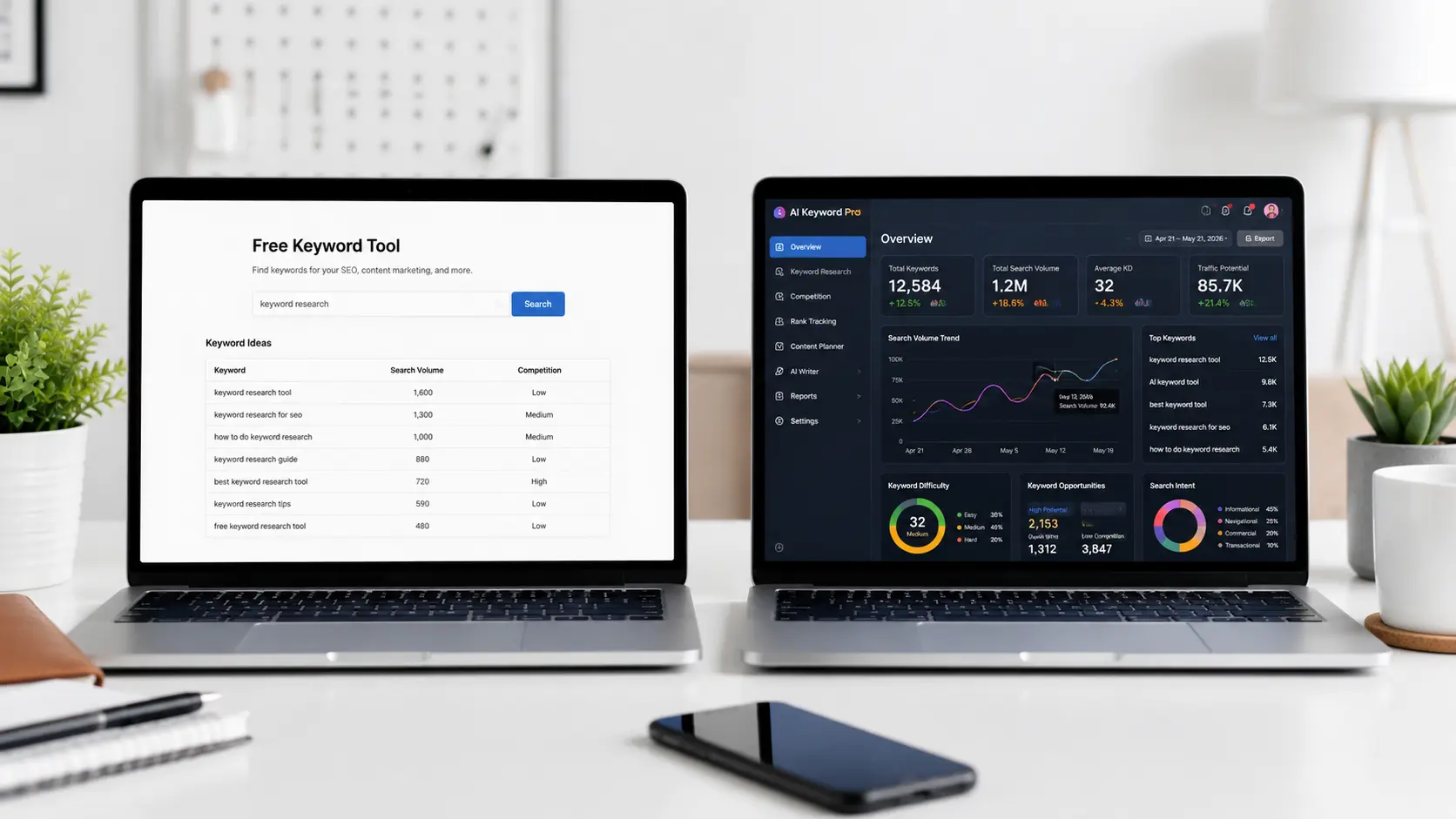
AI keyword research doesn't have to be expensive. In 2026, free AI assistants and keyword tools can handle many basic SEO tasks, while paid platforms become more useful when keyword research needs to be performed at scale.
Free vs Paid AI Keyword Tools: What's the Difference?
Free tools are generally enough for keyword brainstorming, search intent mapping, topic expansion, and basic keyword validation. Paid platforms add more automation, larger datasets, bulk processing, competitor analysis, and ongoing SEO tracking.
Related reads: Common Mistakes in AI-Based Keyword Research (and Fixes)
The right choice depends less on the tool itself and more on the scale of your content operation.
Free AI Keyword Research Tools
For individual creators, bloggers, and small websites, free options can cover most everyday keyword research needs.
- ChatGPT — Useful for keyword brainstorming, search intent mapping, topic clusters, and content ideas.
- Google Gemini — Helpful for expanding keyword ideas, analyzing topics, and exploring different search intents.
- Ubersuggest — Offers free-tier access for basic keyword volume, difficulty, and SEO research.
For a solo blogger publishing a few articles each month, these tools can be more than enough when combined with manual SERP analysis.
Paid AI SEO Tools
Paid platforms become more valuable when you're managing a large content calendar or researching hundreds of keywords.
- Semrush — Offers extensive keyword data, competitor research, bulk analysis, AI-powered workflows, and rank tracking. Plans and pricing can vary, so check the current pricing page before subscribing.
- Ahrefs — Particularly useful for competitor keyword analysis, content-gap research, backlinks, and large-scale SEO research.
The biggest advantage isn't simply having "more keywords." It's saving time through automation and centralized SEO data.
Free or Paid: Which Should You Choose?
The real question isn't which tier is better. It's whether manual keyword validation is still practical at your current scale.
| Your situation | Best starting point |
|---|---|
| A few articles per month | Free tools |
| Solo blogger | Free tools |
| Small business website | Free + one paid tool when needed |
| Dozens of topics | Paid SEO platform |
| Large content operation | Paid platform + automation |
| Competitor-gap research at scale | Paid tools |
If you're publishing a handful of articles each month, an AI assistant combined with a free keyword checker can work perfectly well.
But when you're managing dozens of topics, multiple content clusters, or a growing editorial calendar, manually checking every AI-generated keyword becomes time-consuming. That's where a paid platform can start saving more time than it costs.
A Smart Middle Path
You don't necessarily need several expensive subscriptions.
A practical approach is to start with free tools and upgrade to one paid SEO platform when manual research becomes a significant time cost.
For example, you might use ChatGPT for brainstorming and clustering, then rely on Semrush or Ahrefs for data validation and competitive analysis.
There's rarely a need to maintain multiple paid subscriptions unless your workflow genuinely requires features from each platform.
Read More :- Common Mistakes in AI-Based Keyword Research (and Fixes)
Bottom line: Free AI keyword tools are sufficient for many individuals and small websites. Paid platforms become valuable when scale, automation, competitor research, and time savings matter more than keeping costs at zero.