

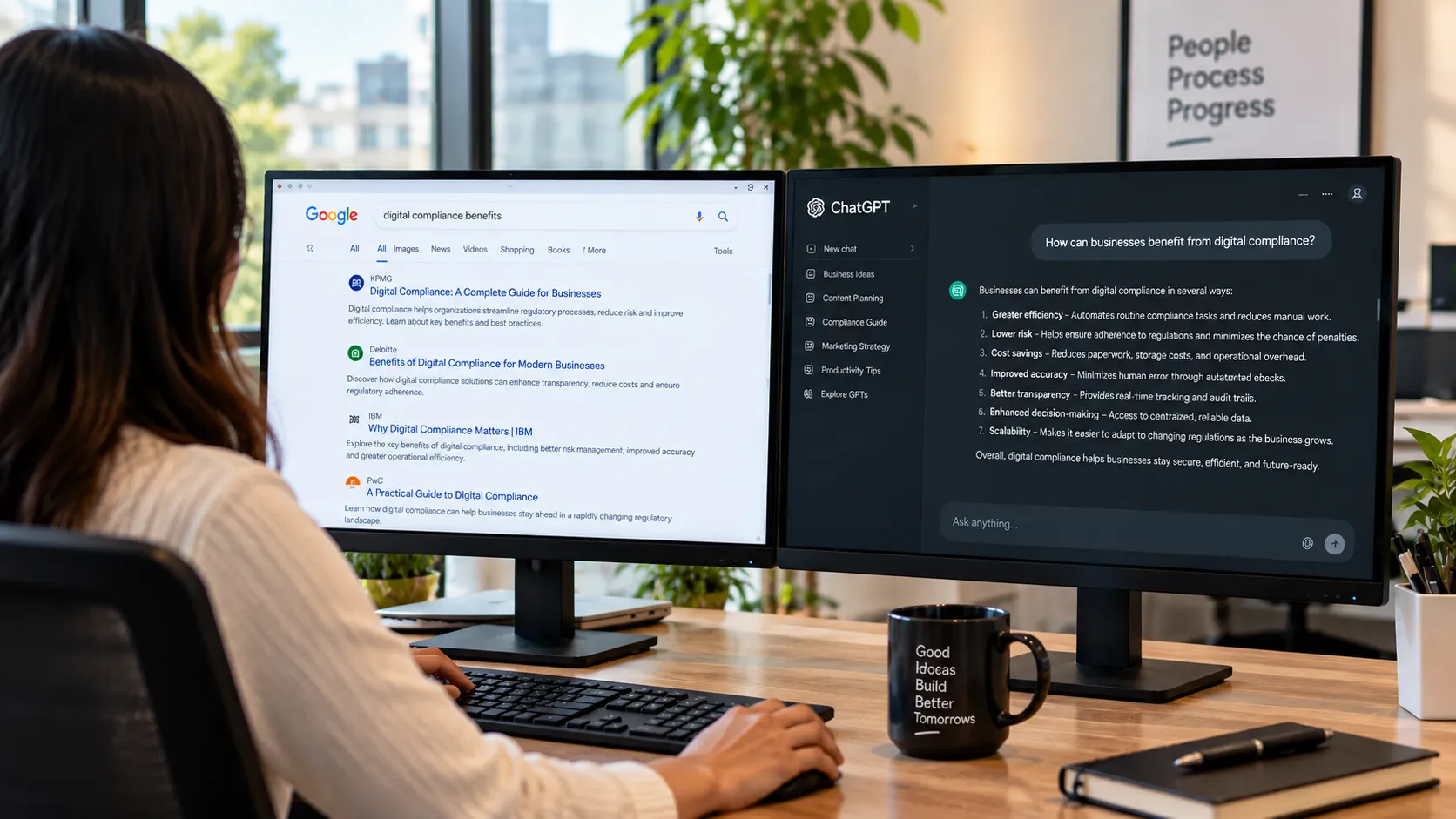
We wanted a straight answer to a question clients keep asking us: "If I rank well on Google, am I safe?" So we picked 200 real queries across client accounts — a mix of commercial and informational intent — and manually checked both Google's top 10 and ChatGPT's answer every week for three months.
The overlap was lower than we expected. In roughly 38% of queries, the top-ranking Google page's brand was never mentioned in ChatGPT's answer to the same question. Informational queries ("how does X work," "what is Y") had the widest gap — ChatGPT tended to synthesize an answer from Wikipedia-style sources and forums rather than brand content, even when that brand ranked #1 on Google.
Commercial queries ("best X for Y," "X vs Z") had much tighter overlap — around 80% — because comparison-style content tends to get lifted directly into AI answers.
The takeaway we've since built into every content brief: informational content needs a distinct AEO pass (clear definitions, structured facts) separate from the SEO pass, because ranking well in one doesn't guarantee visibility in the other.
How we ran the tracking
The method was deliberately simple so any team can repeat it:
- Query selection: real queries taken from client Search Console accounts, split between informational ("what is", "how does") and commercial ("best", "vs", "alternatives") intent.
- Weekly checks: for each query we recorded the brands in Google's top 10 organic results and the brands named in ChatGPT's answer.
- Clean sessions: ChatGPT checks were run in fresh, logged-out sessions where possible so personal history didn't shape the answers.
- Overlap measure: a query counted as "overlapping" when the brand behind the top-ranking Google page was also mentioned in the ChatGPT answer.
Why informational queries showed the biggest gap
For a question like "what is crawl budget", there are hundreds of pages giving similar explanations. An AI model can produce a good answer without naming any single source, and when it does cite sources it often prefers encyclopaedia-style pages, documentation and community discussions. A brand's blog post can rank first on Google because of strong links and relevance, yet offer nothing distinctive enough to be named in a summarised answer.
Why commercial queries overlapped more
Comparison and "best of" queries require naming specific products and companies. The answer can't be written without brands. Pages that already list and compare options in a structured way, with clear pros, cons and use cases, give AI tools ready-made material, so the same brands tend to appear in both places.
What we now add to every brief: the AEO pass
After the usual SEO checks, every informational article gets a second pass focused on being quotable:
- A one- or two-sentence definition or direct answer near the top.
- Specific facts, numbers or steps that are clearly attributed to the brand's own experience or data.
- Question-style subheadings that match how people phrase prompts.
- A short summary or key takeaways block.
- Clear author information and an updated date.
Our guide to citation-ready content goes into each of these.
Limitations of this kind of study
AI answers change between sessions, users and model versions, so any snapshot is approximate. Our queries came from client accounts, which skews towards the industries we work in, and ChatGPT results may differ from Perplexity, Gemini or Google's AI Mode. Treat the numbers as directional, not as a universal benchmark.
How to run this on your own site
- Export your top 50 queries from Search Console and tag each one as informational or commercial.
- For each query, note whether your brand ranks in Google's top 10 and whether it appears in ChatGPT's answer.
- Repeat weekly for at least a month.
- Prioritise queries where you rank well on Google but are missing from AI answers. These are the quickest AEO wins.
Read More : Stop Optimizing for Position #1. Optimize to Be the Answer Instead.
Need a hand with this? Our generative engine optimization (GEO) team can help you put it into practice. Talk to ClicZeo.