




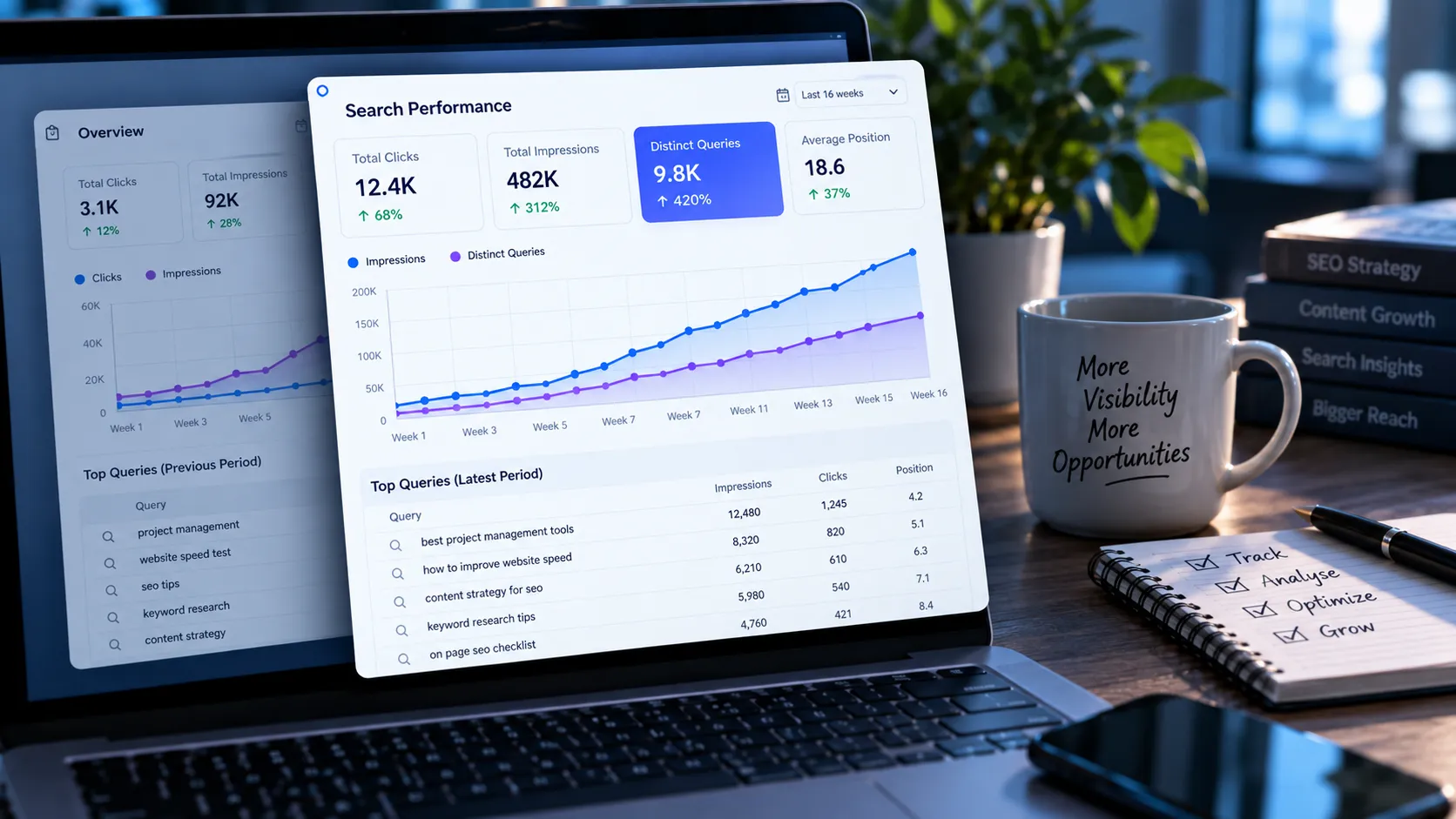
When you're working on SEO, it's easy to become obsessed with impressions.
I definitely was.
I'd make a change and then check the graph, hoping to see an immediate jump.
Eventually, though, I started paying much closer attention to distinct query count per page.
For me, it provided a useful early signal that a page was becoming relevant to a wider range of searches.
Why Query Count Was Useful
Imagine two pages that both receive 10,000 impressions.
One gets those impressions from five major queries.
The other gets them from 200 related searches.
The impression total is identical, but the second page has much broader search coverage.
That's what I wanted to measure.
I wasn't just trying to rank higher for one keyword. I wanted my articles to become useful for the wider topic.
That idea was closely connected to the content-gap process in [Content Gaps That Were Quietly Capping My Impressions].
Query Growth Could Appear Before Impression Growth
One thing I noticed repeatedly was that query count could start moving before impressions really took off.
An article might begin appearing for several new related searches, while the overall impression graph barely changed.
I saw that as an early sign that the content was reaching beyond its original keyword set.
Some of those new queries eventually started generating meaningful impressions.
So I became less impatient about judging an update after only a few days.
How I Tracked It
I didn't use an expensive SEO platform.
I used Google Search Console and compared the queries appearing for important pages over time.
I looked at both the number of queries and the actual queries themselves.
The second part was important.
A growing query count sounds great, but if the new searches are completely irrelevant, the number doesn't tell you much.
I wanted to see whether the new queries were genuinely connected to the topic.
Why I Still Care About Impressions
I'm not saying query count is more important than impressions in every situation.
Impressions still matter.
So do clicks, rankings, CTR, and conversions.
I simply found query coverage useful because it helped me understand what was happening underneath the headline number.
That became particularly useful while tracking the changes discussed in [My Real Before-and-After Impressions Numbers: A Semantic SEO Case Study].
The Bigger Lesson
For me, SEO became much easier to understand once I stopped looking for one perfect metric.
Impressions tell me how often the site appeared.
Query count tells me how broadly a page is being discovered.
Together, they give me a much clearer picture.