




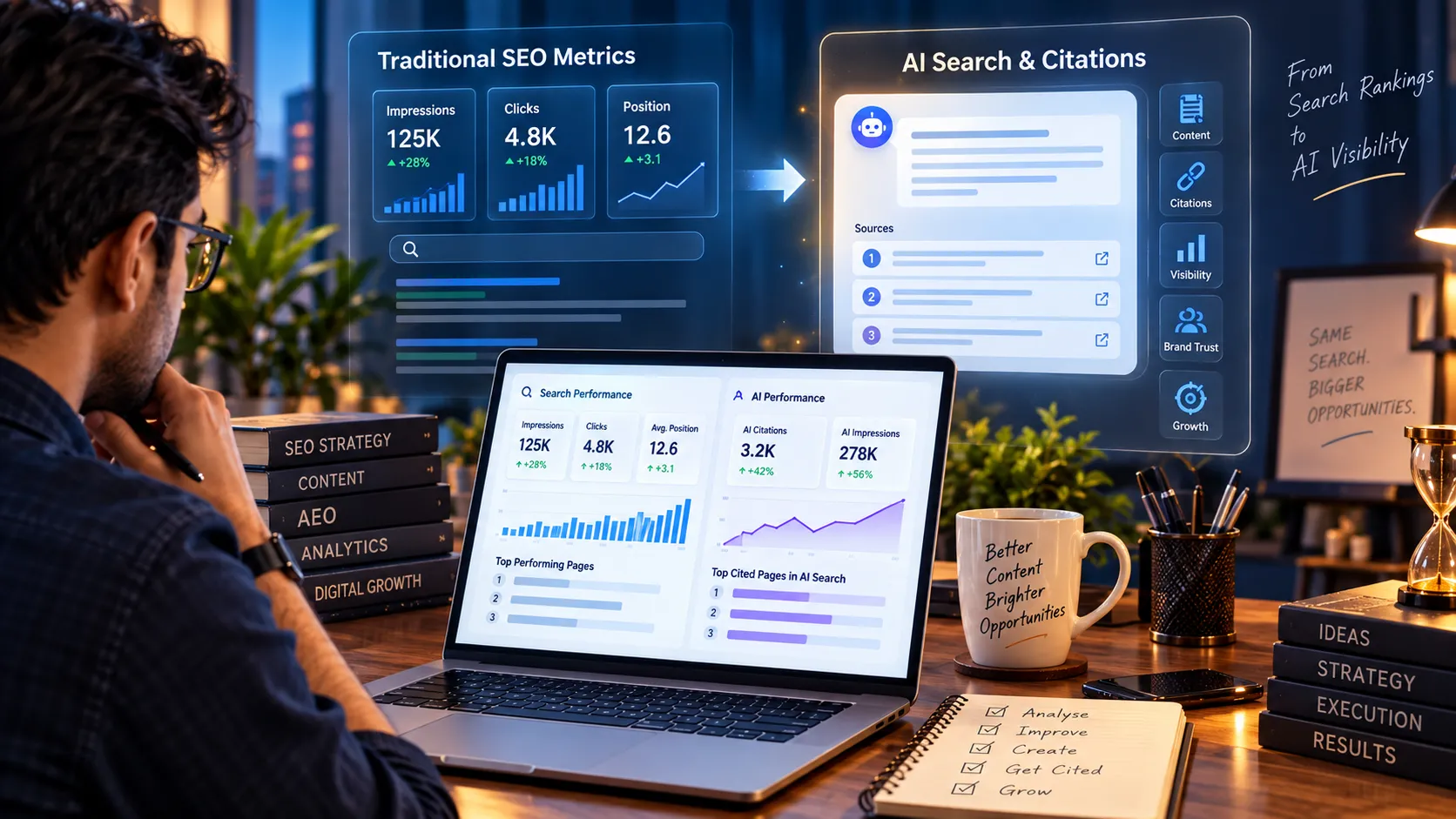
Most SEO reports still celebrate the same three numbers: impressions, clicks, and average position.
Those numbers are useful. They are no longer enough.
In 2026, a growing share of searches never produce a traditional blue-link click. People get answers directly from AI-generated summaries. If your content is being used inside those answers, the old reports often stay quiet. If it is being ignored, the old reports still look healthy.
That gap is exactly why Google added AI Performance data inside Search Console. The feature is now available to websites globally. Most teams in India have either not opened it yet or do not know what to do with the numbers they see.
This post shows you what the report actually measures, how to read it without overreacting, and how to turn the data into better content decisions.
What the AI Performance Report Actually Shows
The classic Search Console performance report tells you how often your pages appeared in regular results and how often people clicked.
The AI Performance view focuses on a different question:
How often is your content being referenced or shown inside Google’s AI-generated search experiences?
You will typically see signals around:
- How often your pages are cited or used as supporting sources
- Impressions connected to AI-assisted results
- Related click activity when users do engage further
These numbers behave differently from normal organic traffic. A page can gain citations while classic clicks stay flat or even dip. That does not automatically mean the page is failing. It often means the way people consume information has shifted.
Why This Matters for Indian Brands Right Now
Three practical reasons:
1. Visibility is splitting
Some queries still send traditional traffic. Others are increasingly answered on the results page itself. If you only watch clicks, you miss half the picture.
2. Clients and leadership are starting to ask
Marketing teams are already being asked whether the brand appears in AI answers. Having a clear report (and a clear explanation) is becoming table stakes.
3. Early movers can still shape the narrative
Many competitors are not tracking this yet. Publishing clear guidance and improving your own citation readiness creates both service differentiation and content authority.
How to Find and Use the Report (Simple Steps)
1. Open Google Search Console for the property.
2. Look for the newer AI-related performance section (wording can vary slightly as the interface continues to settle).
3. Review the available metrics for the last 28 days and compare longer ranges when possible.
4. Note which pages appear most often as sources.
5. Cross-check those pages against your important commercial and informational URLs.
Do not expect the interface to look identical to the classic performance report. The goal is different, so the presentation is different.
How to Read the Numbers Without Panic
A rise in AI-related impressions or citations with flat clicks is not automatically bad.
It can mean your content is being trusted as a source even when the user does not leave the results page.
A drop in classic clicks on queries that now trigger AI summaries is also not automatically a failure of your SEO. It is often a change in user behaviour.
What you should watch for:
- Which of your strongest pages are completely absent from AI-related data
- Whether new or updated pages start appearing as sources after you improve structure and clarity
- Whether brand-related searches begin to lift even when informational clicks stay soft (this sometimes signals growing recognition)
Use the report as a visibility signal, not as a pure traffic target.
What to Do With the Insights
Once you know which pages are (and are not) being referenced, take practical action:
- Strengthen the pages that already get cited. Make the core answer clearer and higher on the page.
- Improve pages that should be cited but are missing. Add direct answers, clearer headings, better structure, and stronger E-E-A-T signals.
- Create supporting content that fills gaps your current pages leave open.
- Connect related articles so both users and systems can see the topical relationship.
This is where your existing work on Answer Engine Optimisation and citation-ready writing starts to pay off. The report simply shows you whether that work is registering.
How This Fits With the Rest of Your Strategy
Treat the AI Performance data as one more layer, not a replacement:
- Continue tracking classic organic performance.
- Continue improving content for Google Discover where the topics are timely and visual.
- Use festive and seasonal content (the 8-week window we covered earlier) as a live testing ground. Early, clear answers have a better chance of being referenced while intent is building.
- Keep technical foundations solid — clean structure, useful schema, and readable pages still matter.
When you publish new guides, link them naturally to your main measurement page and to related clusters (festive timing, Discover optimisation, and broader AI search guidance). This builds clearer topical strength over time.
A Realistic Weekly Habit
You do not need to live inside the report.
Once a week:
1. Check which pages appear in the AI-related data.
2. Note any important URLs that remain absent.
3. Pick one improvement to ship (clearer answer block, better headings, stronger supporting page).
4. Record the change so you can review impact later.
Small, consistent improvements beat occasional large rewrites.
Final Thought
Rankings and clicks still matter.
They no longer tell the full story.
The teams that learn to read AI visibility alongside traditional metrics will make better decisions, set clearer expectations with clients, and notice problems (or opportunities) earlier.
Open the report this week. Look at what is already being referenced. Then decide what deserves attention next.
The data is available. The only remaining step is using it.