




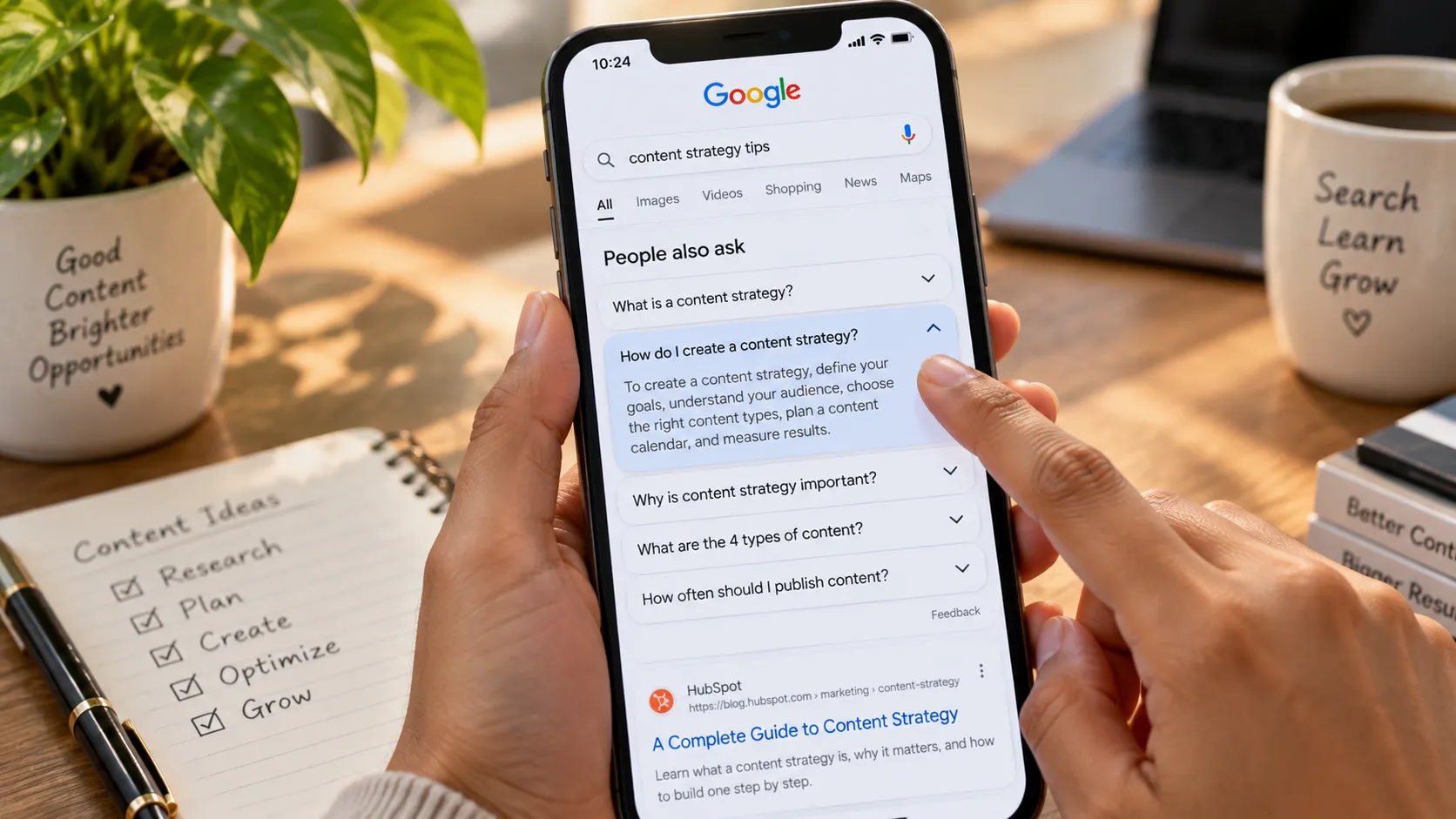
I used to look at Google's People Also Ask box for keyword ideas.
Now I use it differently.
I treat it as a quick test for an article I've already written.
I search the main topic, open the relevant questions and compare them with my content.
The question I ask is simple:
"Would my article actually answer this?"
If the answer is no, I make a note of it.
I Don't Add Every Question
This is where I had to become more selective.
Not every PAA question belongs in my article.
Some are too broad.
Some are only loosely related.
Some deserve their own page.
I only add a question when it makes the existing article genuinely more useful.
That's the same approach I use when finding gaps across an entire topic, which I explained in Content Gaps That Were Quietly Capping My Impressions.
What If PAA Doesn't Show Up?
It happens.
Some searches don't give me enough useful questions.
When that happens, I use AlsoAsked to explore related question relationships.
I also use AnswerThePublic for additional question and phrase ideas.
And if I'm checking whether interest in a topic is changing, I'll use Google Trends.
These tools don't tell me what I must write.
They simply give me more places to look.
The Best Question I Found
The most useful questions aren't always the ones with the biggest apparent search volume.
Sometimes it's a very practical question that tells me what readers actually worry about.
That's the kind of gap I want.
Because if one reader is likely to ask it, many others may have the same problem.
My PAA Workflow
My process is pretty simple:
- Search the main topic.
- Open the relevant PAA questions.
- Check around 8–10 useful questions first.
- Compare them with the article.
- Separate genuine gaps from unrelated questions.
- Add only the questions that improve the article.
- Link to another article when the topic deserves deeper coverage.
That last step is important.
A content gap doesn't always mean "add another paragraph."
Sometimes it means "this deserves its own article."
And that's where topic clusters become useful. See Topic Clusters: The Structural Fix That Widened My Impressions.