




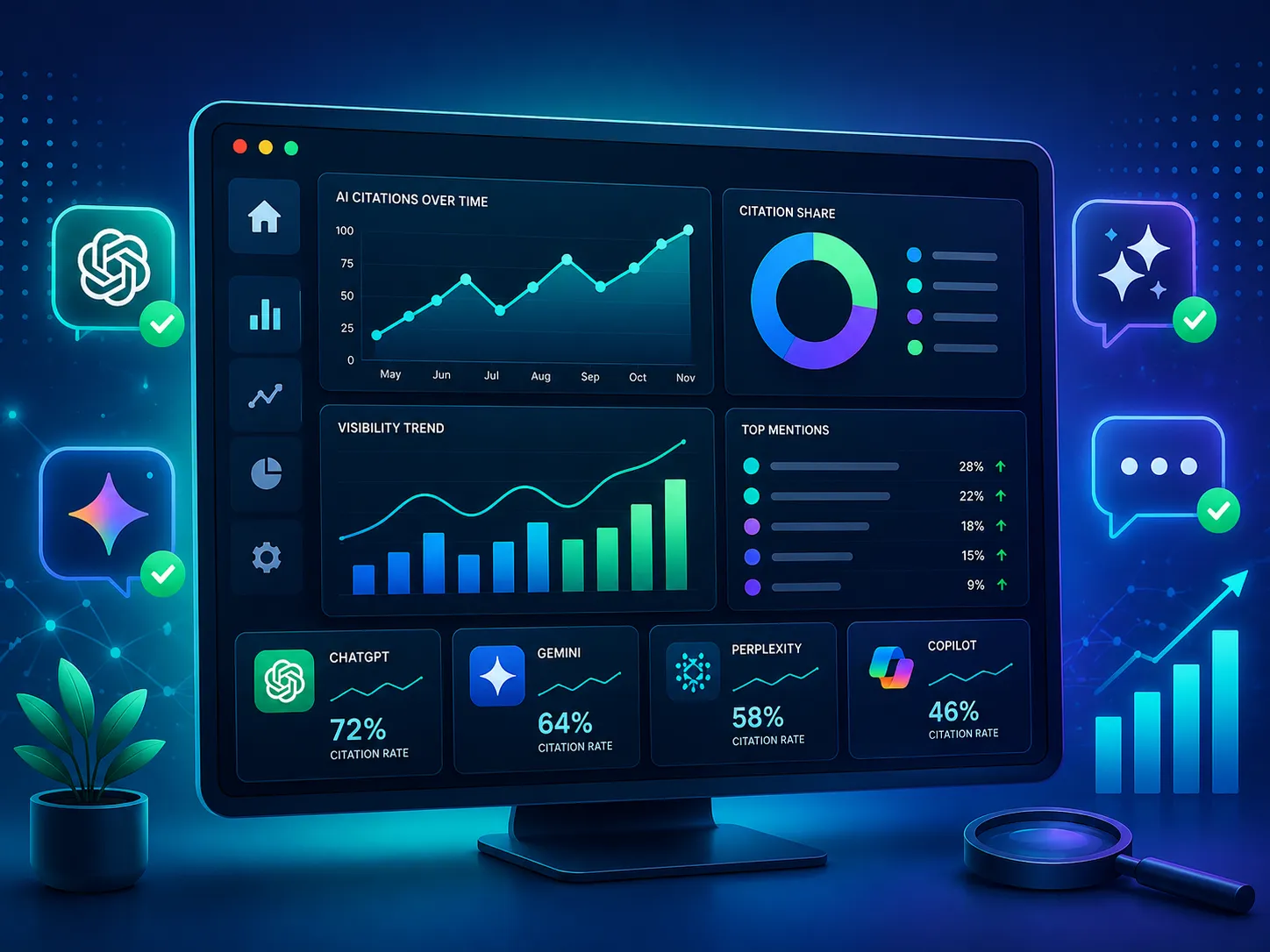
GEO (Generative Engine Optimization) is becoming a measurable part of search marketing. Instead of tracking only Google rankings, businesses can now monitor how often their brand appears in AI-generated answers.
GEO tools help track brand mentions, citations, competitors, prompts, and visibility across platforms such as ChatGPT, Gemini, Perplexity, and Google AI.
Here are some of the best GEO tools to consider in 2026.
What Do GEO Tools Measure?
Most GEO platforms track:
- Brand mentions in AI answers
- Website citations and cited pages
- Competitor visibility
- AI Share of Voice
- Sentiment and context
- Performance across target prompts
- Changes in AI visibility over time
Results should be treated as directional, because AI answers can vary depending on the prompt, location, model, and time of testing.
Best GEO Tools in 2026
1. OtterlyAI — Best for Dedicated AI Visibility Tracking
OtterlyAI is built specifically for AI search monitoring. It tracks Google AI Overviews, ChatGPT, Perplexity, and Microsoft Copilot, with Google AI Mode, Gemini, and Claude available as add-ons. It also supports daily tracking and competitor/brand reporting.
Best for: Businesses, agencies, and marketers starting with GEO.
Pricing: Free tier available; paid plans include Lite, Standard, Premium, and Enterprise options.
2. Peec AI — Best for AI Search Analytics
Peec AI focuses on AI search analytics for brands and SEO teams. It provides prompt tracking, AI visibility analysis, competitor insights, and daily monitoring. Its plans allow users to choose the AI models they want to track.
Best for: SEO teams, content marketers, and agencies.
Pricing: Plans are available for brands and agencies, with the Starter plan including 50 prompts, three models, one project, and daily tracking.
3. Semrush AI Visibility — Best for SEO + GEO
Semrush combines traditional SEO data with AI visibility tracking. Its AI Visibility Toolkit monitors mentions across ChatGPT, Google AI, Gemini, and Perplexity, while also providing competitor analysis, prompt research, and AI-readiness checks.
Best for: SEO teams that want traditional SEO and GEO data in one platform.
Pricing: Starts at $99/month per domain when billed annually.
4. Ahrefs Brand Radar — Best for AI Visibility Research
Ahrefs Brand Radar lets marketers research brand visibility across hundreds of millions of search-backed prompts. It can track mentions, citations, AI Share of Voice, competitors, and custom buyer prompts across major AI platforms.
Best for: SEO professionals, publishers, and established brands.
Pricing: Brand Radar AI starts at £159/month; custom prompt tracking is also available from £40/month.
5. Scrunch — Best for Enterprise AI Monitoring
Scrunch combines AI visibility monitoring with website AI-readiness and crawler insights. Its Enterprise offering supports ChatGPT, Claude, Perplexity, Gemini, Meta AI, Google AI Mode, Google AI Overviews, Copilot, and Grok.
Best for: Enterprise brands and agencies.
Pricing: Core starts at $250/month and includes 125 unique prompts and five site audits per month.
6. Profound — Best for Enterprise GEO
Profound is an enterprise-focused AI search visibility platform designed to help brands understand how AI systems discover, mention, and recommend them.
Best for: Large brands and enterprise marketing teams managing GEO at scale.
Read Also : GEO vs AEO: What's the Difference Between Generative and Answer Engine Optimization?
How to Choose a GEO Tool
Before choosing a platform, check:
- AI coverage: Does it track the platforms your audience uses?
- Prompt volume: Can you monitor enough important queries?
- Citation data: Does it show which websites AI cites?
- Competitor tracking: Can you benchmark against competitors?
- Reporting frequency: Daily tracking is useful for detecting changes quickly.
- Recommendations: Does the tool tell you what to improve?
Final Takeaway
The best GEO tool depends on your needs. OtterlyAI is a strong dedicated starting point, Peec AI focuses on AI-search analytics, Semrush and Ahrefs are useful for SEO teams, while Scrunch and Profound are better suited to larger organizations.
The goal isn't simply to count AI mentions. Use GEO data to discover which prompts you are missing, which competitors are winning, and which sources AI trusts—then use those insights to improve your content and visibility.