




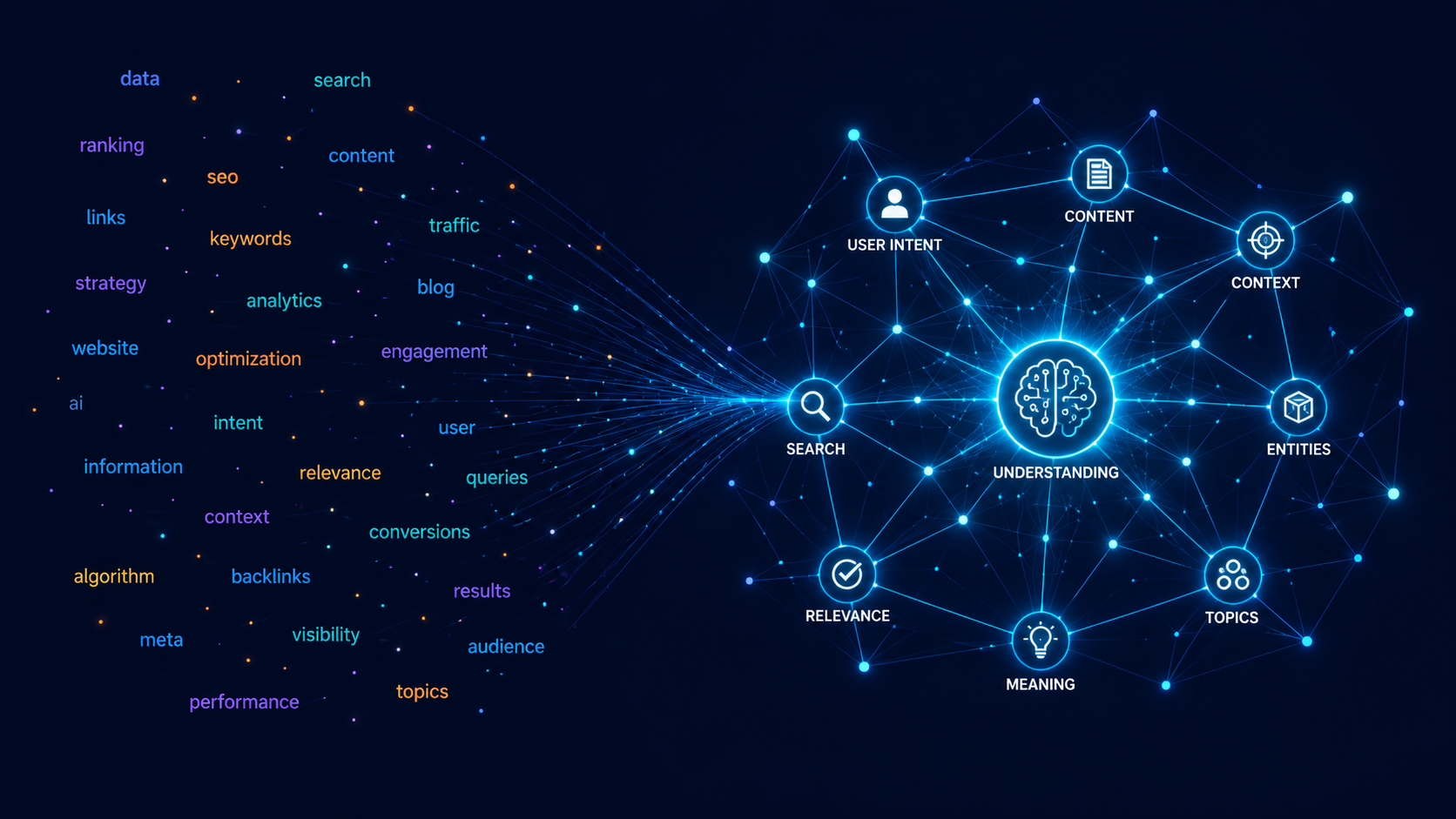
SEO used to be heavily focused on exact-match keywords. If you wanted to rank for “best digital marketing agency,” you might have repeated that exact phrase throughout the page, including in headings, paragraphs, and metadata.
That approach is becoming less important.
Search engines have become much better at understanding meaning, context, relationships between words, and user intent. AI-powered search can recognize that phrases such as “top digital marketing company,” “best agency for online marketing,” and “digital marketing services” may relate to the same broader topic.
This is where semantic search comes in.
Instead of asking whether a page contains the exact keyword enough times, modern search systems can evaluate whether the page actually provides useful and comprehensive information about the subject.
What Is Semantic Search?
Semantic search is Google's ability to understand the meaning behind a search query, rather than relying only on matching individual words.
For example, someone might search:
“How can I get more customers from Google?”
A useful page doesn't necessarily need to repeat that exact sentence. It could discuss Google Business Profile optimization, local SEO, reviews, local keywords, Google Maps visibility, and other relevant strategies.
The important factor is whether the content addresses the user's underlying need.
Why Exact-Match Keyword Strategy Is Changing
Exact-match keywords aren't completely useless. They can still help search engines and readers understand what a page is about, particularly when used naturally in titles, headings, and important sections.
The problem is forced repetition.
Writing the same phrase repeatedly can make content awkward and less useful. Modern SEO is moving toward topic coverage rather than keyword frequency.
A better approach is to start with one core topic and identify:
- Related keywords and synonyms
- Questions users commonly ask
- Subtopics that belong to the subject
- Different search intents
- Examples and supporting concepts
These become the foundation of the content rather than a strict keyword-density target.
How to Write for Semantic Search in 2026
Start with the topic, not just the keyword.
For example, if your main topic is “local SEO,” your content could naturally cover Google Business Profile, local citations, reviews, location-based keywords, NAP consistency, Google Maps, and local ranking factors.
You don't need to force every term into the article. If the content genuinely explains the topic, many related terms will appear naturally.
A simple test is to read your content aloud. If a keyword sounds like it was inserted for a search engine rather than written for a person, rewrite the sentence.
Tools Worth Using
Frase — Helps analyze search results and identify related topics, questions, and terms that can strengthen content coverage.
Surfer SEO — Provides content optimization recommendations based on the topics and terms appearing across relevant search results.
MarketMuse — Helps build topic models, identify content gaps, and understand how comprehensively a subject is covered.
Ahrefs — Useful for discovering related keywords, search opportunities, competitors, and content gaps around a broader topic.
Also read - Search Intent Analysis Using AI in 2026
Quick Takeaway
Exact-match keywords aren't dead—but exact-match keyword stuffing is increasingly outdated.
In 2026, focus on creating content that covers a topic thoroughly, answers related questions, matches search intent, and reads naturally.
Think “topic first, keyword second.” When the content genuinely satisfies the searcher's need, you don't have to force every variation of a keyword onto the page.