




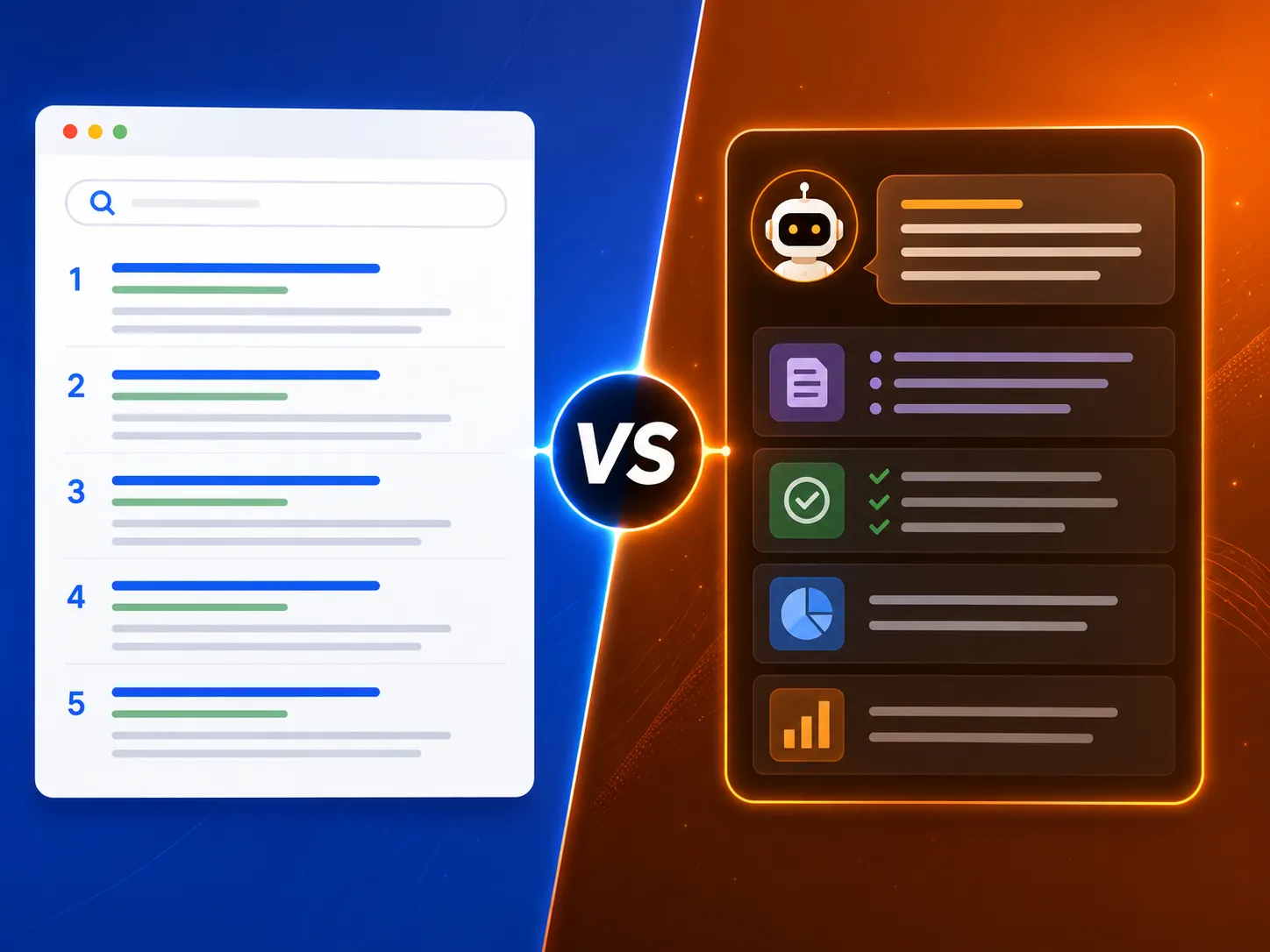
Search is changing. People are no longer relying only on traditional search results—they are also asking AI tools for direct answers, recommendations, comparisons, and summaries.
That’s where GEO (Generative Engine Optimization) comes in.
So, is GEO replacing SEO? No. SEO helps your content become discoverable and authoritative in traditional search, while GEO focuses on making that content easier for AI systems to understand, trust, and potentially cite.
Here are the 7 key differences between GEO and SEO every marketer should understand.
1. What They Optimize For
SEO focuses on visibility in traditional search results. GEO focuses on increasing the likelihood that your brand or content is represented in AI-generated answers.
SEO aims to improve rankings, impressions, clicks, and organic traffic.
GEO focuses on becoming a useful, trustworthy source that AI systems can extract, summarize, mention, or cite.
2. Success Metrics Are Different
SEO is commonly measured through:
- Keyword rankings
- Organic impressions
- Click-through rate
- Organic traffic
- Conversions
GEO introduces additional signals such as:
- AI citations
- Brand mentions in AI answers
- Visibility across generative search experiences
- Referral traffic from AI platforms
- How frequently your content appears as a cited source
The best strategy is to track both sets of metrics, rather than treating GEO as a replacement for SEO.
3. Content Structure Matters More for AI
Traditional SEO content often targets keywords, search intent, headings, internal links, and comprehensive coverage.
GEO adds another priority: make important answers easy to identify and extract.
Instead of hiding the answer deep inside a long paragraph, give a concise answer immediately below the relevant heading, then provide supporting evidence and context.
For example:
What is GEO?
GEO is the practice of optimizing content so generative AI systems can understand, use, and potentially cite it in AI-generated responses.
This answer-first structure can benefit both readers and search engines.
4. Authority Goes Beyond Backlinks
SEO has traditionally placed significant emphasis on backlinks, topical relevance, technical quality, and overall site authority.
GEO also makes entity-level trust and credibility increasingly important.
AI systems need signals that help establish whether a company, author, product, or publication is legitimate and knowledgeable.
Consistent information across reputable websites, expert authorship, original research, credible references, news coverage, and strong brand recognition can all contribute to this broader authority picture.
5. Technical Optimization Has Expanded
SEO fundamentals still matter: crawlability, indexing, site architecture, internal linking, structured data, mobile usability, and performance.
For GEO, marketers should additionally make content highly understandable to machines through:
- Clear semantic HTML
- Descriptive headings
- Structured data where appropriate
- Well-organized FAQs
- Accessible, machine-readable content
- Clear author and organization information
Tools such as llms.txt are being explored by the industry, but they should not be treated as a guaranteed requirement for AI visibility.
6. Freshness Matters
AI-generated answers can depend heavily on the information available to the system, especially for topics involving products, statistics, technology, regulations, and current events.
That makes content freshness increasingly important.
Review outdated statistics, broken references, old screenshots, discontinued products, and claims that may no longer be accurate.
A page that ranks well but contains outdated information may be less useful than a recently updated, well-supported source.
7. Measurement Requires New Testing
SEO marketers already have tools such as Google Search Console, analytics platforms, and rank trackers.
GEO measurement is still evolving.
Marketers can test their visibility by running relevant prompts across AI search and conversational platforms and recording:
- Whether the brand is mentioned
- Whether the website is cited
- Which competitors appear
- Which sources are repeatedly referenced
- Whether answers change after content updates
Because AI responses can vary, GEO measurement should be treated as an ongoing testing process rather than a single fixed ranking report.
Do You Need Both SEO and GEO?
Yes.
SEO and GEO are complementary strategies.
Strong SEO helps your website get discovered, indexed, and recognized as an authoritative source. GEO helps you structure and present that information in a way that is useful for generative AI systems.
Think of it this way:
SEO gets you discovered. GEO helps you become part of the answer.
For a deeper introduction, read our [GEO guide / Pillar Blog 1].
Read More : What Is GEO? The Complete Guide to Generative Engine Optimization in 2026
Final Takeaway
GEO isn't SEO's replacement—it's the next layer of search visibility.
Continue building technically strong, authoritative SEO content, but make that content clear, structured, current, evidence-based, and easy for AI systems to understand.
The brands that combine SEO fundamentals with GEO-focused content practices will be better positioned for the future of search.