




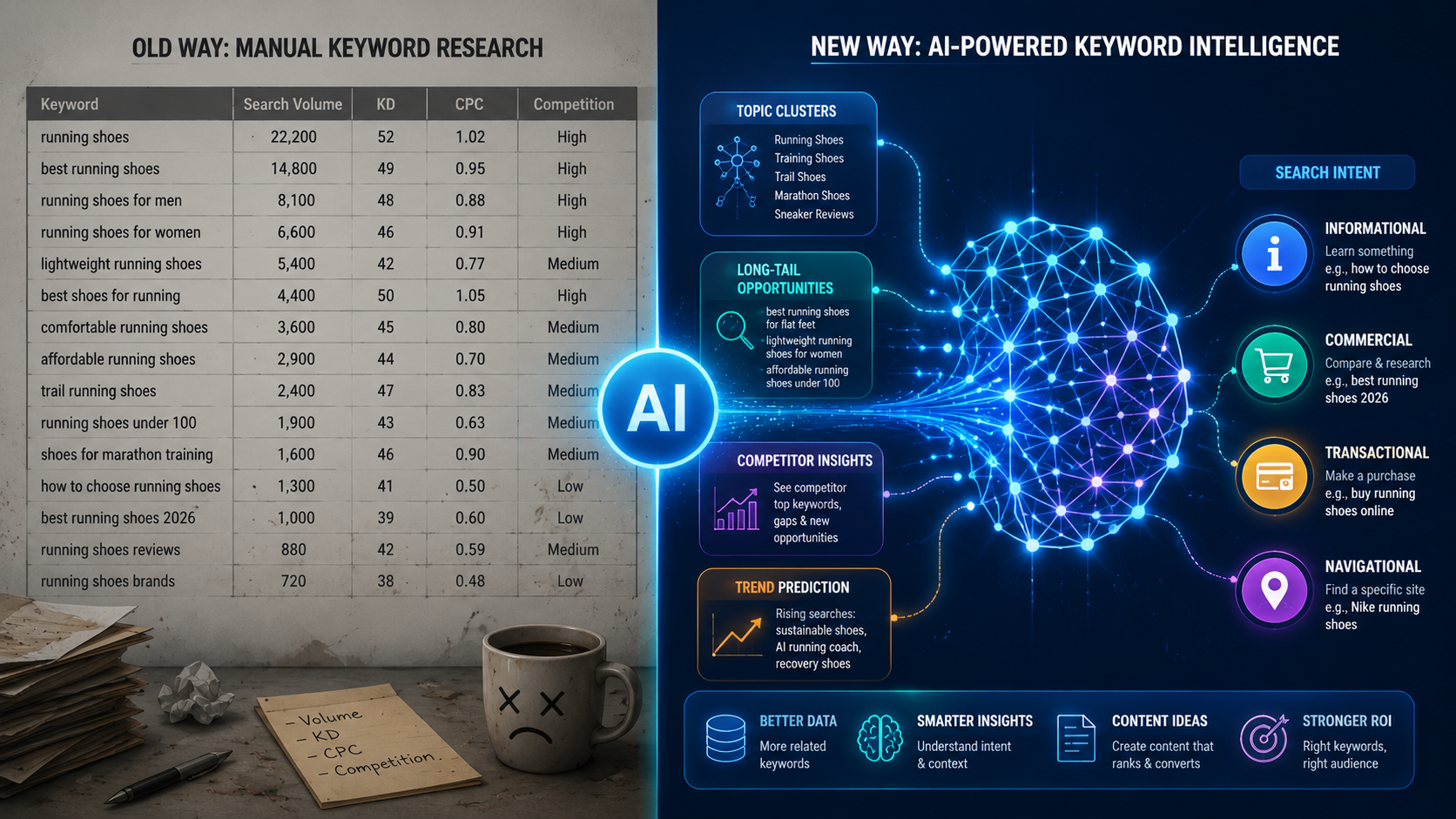
Keyword research has changed significantly over the last few years. Search volume, keyword difficulty, and competition are still important, but they are no longer the complete picture.
In 2026, AI is helping SEO professionals understand why people search, how related queries connect, and which topics should be covered together. Instead of creating separate pages for every keyword variation, marketers can now build content around a broader search intent and cover multiple related queries naturally.
For example, someone searching for “best running shoes,” “running shoes for beginners,” and “affordable running shoes” may have the same basic goal: finding the right running shoes to buy. Rather than creating three thin articles, a stronger strategy is to create one comprehensive page that addresses the different questions within that buying journey.
This shift makes keyword research less about collecting hundreds of keywords and more about understanding topics, intent, and opportunities.
What Has Changed in Keyword Research?
Traditional keyword research often started with a primary keyword and focused heavily on metrics such as monthly search volume and keyword difficulty.
AI-assisted research adds another layer: intent mapping and clustering.
AI can help identify related queries, organize keywords into meaningful groups, uncover content gaps, and suggest subtopics that may otherwise be missed. Modern SEO platforms are also using AI to analyze search intent and help marketers discover keyword opportunities faster.
The goal is not to target every keyword separately. The goal is to determine which queries can realistically be answered by the same page.
Tools Worth Using for AI Keyword Research
1. ChatGPT
ChatGPT can help brainstorm keyword variations, identify search-intent categories, generate related questions, and organize a large keyword list into potential content clusters.
Use it for initial research and idea generation, but validate important SEO metrics with a dedicated keyword research platform.
2. Google Gemini
Google Gemini is useful for expanding a topic into related questions, subtopics, and content angles. It can be particularly helpful during the brainstorming stage when you want to explore how people might phrase different searches.
3. Semrush
Semrush combines traditional keyword data with AI-assisted research and keyword clustering. Its Keyword Strategy Builder can organize related keywords into clusters using factors including search intent and SERP similarity.
This makes it useful for turning a large keyword list into an actionable content plan.
4. Ahrefs
Ahrefs provides keyword ideas, search-intent analysis, competitor research, and AI-powered keyword suggestions. Its Keywords Explorer can generate keyword ideas and cluster related terms, while its AI features can help identify search intent.
Read more : How to Use ChatGPT for Keyword Research (Step-by-Step)
A Better 2026 Keyword Research Workflow
A practical workflow is simple:
Step 1: Start with a broad topic or seed keyword.
Step 2: Use AI to generate related questions, variations, and subtopics.
Step 3: Use tools such as Semrush or Ahrefs to validate search volume, difficulty, competition, and intent.
Step 4: Group keywords that share the same search intent.
Step 5: Decide whether each cluster deserves a new page or should be included in an existing page.
Step 6: Build comprehensive content that answers the main query and its relevant supporting questions.
Quick Takeaway
AI has not made keyword research irrelevant—it has made it more strategic.
The best approach in 2026 is to combine AI's ability to understand patterns and generate ideas with reliable SEO data. Use AI for breadth, clustering, and content discovery, then use real search data to validate demand and competition.
The result is a smarter content strategy: fewer unnecessary pages, stronger topical coverage, and content designed around what users actually want to know.